Recent comments in /f/askscience
BeneficialWarrant t1_j234w9l wrote
Reply to In Parkinson disease, why doesn't the adrenal gland fill the dopamine deficiency? by Actual-Pumpkin1567
Another way to think of it is that Parkinson's disease isn't a disorder of insufficient dopamine. Its a disorder of insufficient dopamine-releasing neurons. Treatment with dopamine precursors can increase the activity of remaining dopaminergic neurons of the SNpc. As the disease continues to progress, dopamine precursors become less effective.
_felagund t1_j2336gg wrote
Reply to Ask Anything Wednesday - Economics, Political Science, Linguistics, Anthropology by AutoModerator
What is the most comprehensive language spoken by another species?
[deleted] t1_j232t11 wrote
Reply to comment by CaptainDadJoke in In Parkinson disease, why doesn't the adrenal gland fill the dopamine deficiency? by Actual-Pumpkin1567
[removed]
[deleted] t1_j232rml wrote
[removed]
[deleted] t1_j232btf wrote
Reply to comment by robot_tron in Ask Anything Wednesday - Economics, Political Science, Linguistics, Anthropology by AutoModerator
[removed]
SpellingIsAhful t1_j231i4b wrote
Reply to comment by skywalkerze in Ask Anything Wednesday - Economics, Political Science, Linguistics, Anthropology by AutoModerator
The dive issue wouldn't really play in here though because nitrogen dissolves in the blood over time due to breathing pressurized air. If the pressure was enough of a difference you could be crushed, but just as importantly when the pressure disappears your lungs could explode I suppose if you didn't breathe out.
[deleted] t1_j230hjj wrote
[removed]
CaptainDadJoke t1_j22zx43 wrote
Reply to comment by [deleted] in In Parkinson disease, why doesn't the adrenal gland fill the dopamine deficiency? by Actual-Pumpkin1567
see, this is why I tell people they're wrong when they call me smart. I understood maybe a quarter of all of this :D You beautiful amazing people are awesome, I love seeing someone talking shop about their craft like this. Keep up the good work and I thank you all for this I now have lots of things to google while I'm stuck here at work.
tecmobowlchamp t1_j22zua2 wrote
Reply to Ask Anything Wednesday - Economics, Political Science, Linguistics, Anthropology by AutoModerator
Why haven't we figured out a proper form of government that hears what the people want but also listens to common sense?
Also, why do we still allow lobbyists?
[deleted] t1_j22zq0i wrote
Reply to comment by Additional-Fee1780 in Ask Anything Wednesday - Economics, Political Science, Linguistics, Anthropology by AutoModerator
[removed]
[deleted] t1_j22zket wrote
[deleted] t1_j22z35d wrote
Reply to comment by kruel1 in In Parkinson disease, why doesn't the adrenal gland fill the dopamine deficiency? by Actual-Pumpkin1567
This is very well written.
I'd add that levodopa gets converted to dopamine by decarboxylation, but to ensure this only happens in the brain (where it is actually required) and not in the rest of the body (since a dopamine overdose would not be in our interests) we use carbidopas which are peripheral DOPA decarboxylase inhibitors (DDCI)
[deleted] t1_j22xz11 wrote
manwithsillymustache OP t1_j22xk9t wrote
Reply to comment by DingoZoot in Did the same strand of virus cause spanish flu and swine flu? if no then how are they different by manwithsillymustache
ohhh
manwithsillymustache OP t1_j22xf9j wrote
Reply to comment by Crazy-Delay-5149 in Did the same strand of virus cause spanish flu and swine flu? if no then how are they different by manwithsillymustache
thank you so much
eleanor48 t1_j22xdpy wrote
No. That used to be a common theory, especially when you think of animals like elephants grieving and having funerals. But crows can hold grudges and in studies rats have released their friends from small cages rather than do meth or coke or whichever drug was on offer. Evidence of complex emotion is tricky to quantify but intelligence is a bit easier. Parrots and corvids are incredibly intelligent and have very small brains, I believe the current leading theory links intelligence with number of synapses rather than neurons. (Connections rather than brain cells)
[deleted] t1_j22x0zl wrote
Surrational0 t1_j22vmza wrote
Reply to comment by Exceedingly in Ask Anything Wednesday - Economics, Political Science, Linguistics, Anthropology by AutoModerator
>This makes sense to me as printing money dilutes the value of currency, making everything more expensive across the board rather than one specific sector.
So, this relationship between money supply and inflation is definitely correct and likely a major driver of current inflation. However, money supply is not always the primary driver of inflation there are other drivers that can at times be more or less important.
Now, Dr. Friedman certainly believed that money supply was the primary cause of inflation. Though reading his most important work written with Ms. Schwartz he was not as dogmatic as you might see on old TV clips. Check out this bigger picture Wikipedia graph and you can see that the correlation between changes in money supply and inflation is not straightforward even when you consider delayed effects. Certainly if it were a simple relation then an independent central bank would have an easy time keeping inflation under control.
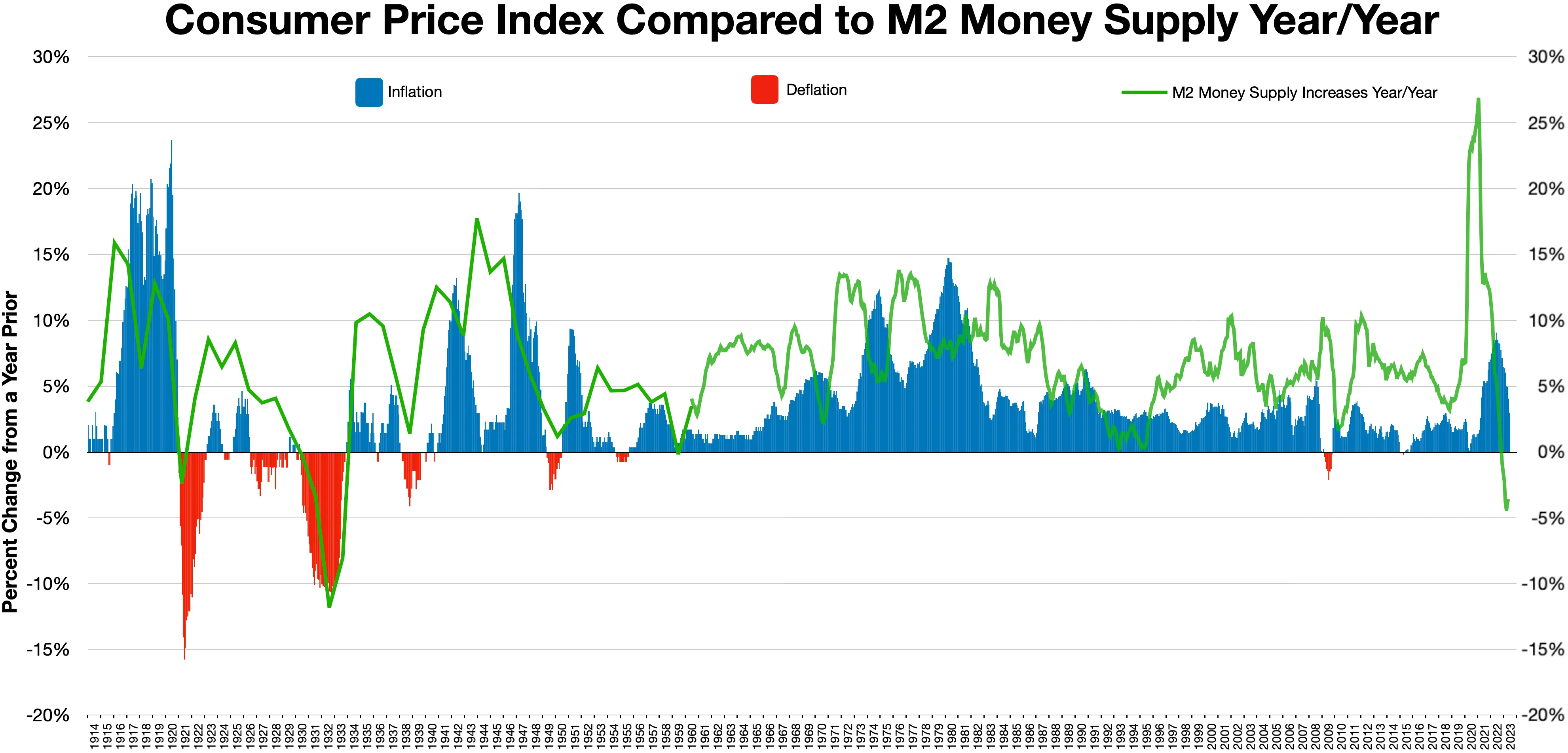
So, what else can drive inflation? Along with the supply of money another very important driver is the supply of things to buy with that money. For instance, if the supply of oil decreases and the supply of money were to stay the same, because oil is pretty necessary for our current society we would experience inflation. The bank of Australia has a broader primer on inflation that has more detail than I can get into here including the important aspect of peoples' behavior. Today both money supply, as you noted, but also many, supply, shocks, are driving inflation upwards quickly.
Good news: a market correction is definitely not the only way to reduce inflation. There are plenty of examples but a recent one is inflation rates dropped quite low through the 2010s with generally decent economic growth. Bad news: market downturns don't always bring down inflation either. Central banks are currently trying to reduce inflation without causing a major downturn. It is not an easy task, however, and there are many drivers of inflation that are out of the control of the reserve banks and governments.
mishgan t1_j22vhwz wrote
Reply to comment by No_Nefariousness_404 in Ask Anything Wednesday - Economics, Political Science, Linguistics, Anthropology by AutoModerator
Cause it will run out and there is no way to produce more, unless long periods of time are involved.
Helium on earth was produced over billions of years by decay of elements, such as uranium.
Earth-helium's final destination is space, it just sticks around places like natural gas wells, then canisters, then party balloons, etc. But one way or the other Helium will end up in space. That's cool.
It being very very finite makes it pretty cool, too.
[deleted] t1_j22u583 wrote
Reply to comment by kruel1 in In Parkinson disease, why doesn't the adrenal gland fill the dopamine deficiency? by Actual-Pumpkin1567
[removed]
[deleted] t1_j22tom3 wrote
Reply to comment by [deleted] in What is the timeline of star death? by jfgallay
[removed]
jfgallay OP t1_j22ta21 wrote
Reply to comment by rootofallworlds in What is the timeline of star death? by jfgallay
Thank you. OP here. That is a much more exponential time frame than I thought. Are transuranic elements the result of rebounding raves (I'm actually a musician) creating higher pressures? Or do they only exist in >25 stars?
jfgallay OP t1_j22sqmb wrote
Reply to comment by [deleted] in What is the timeline of star death? by jfgallay
Hi, I'm OP and my original question was what is the timeline? I wouldn't think it is linear, i.e. the star produces iron at the same time as He.
SonOfOnett t1_j22snxg wrote
Reply to comment by Ecl1psed in Ask Anything Wednesday - Physics, Astronomy, Earth and Planetary Science by AutoModerator
The problem with your argument is you are saying Alice is going to measure a 1: that’s a hidden variable you are introducing into the thought experiment! In reality and experiment, regardless of who measures first, we don’t know what the outcome of that first measurement will be.
You need to stop after stating that Bob and Alice’s particles are entangled to have the same measurement. Given that, neither observer, no matter how close in time to the start of the entanglement will know what they are going to measure, just that their measurements will match.
Veritasium has a decent video on Bells Inequality that may be useful to you as well. It explains how we can tell the difference between a local hidden variable or not
ccdy t1_j235z5v wrote
Reply to comment by jfgallay in What is the timeline of star death? by jfgallay
There are two main astrophysical processes that produce heavy nuclides, the s-process and the r-process. Both involve neutron capture onto stable nuclides followed by beta decay, but they differ greatly in terms of timescale. The s-process (s for slow) occurs in environments where there is a low but stable neutron flux, such that nuclei have a good chance of decaying before they capture another neutron. The r-process (r for rapid), on the other hand, happens when the neutron flux is so high that beta decay is slow compared to neutron capture. Consequently, nuclei get stuffed with as many neutrons as they can physically hold, until they undergo beta decay and can accept more neutrons.
The s-process is limited to the heaviest stable element, lead, because further neutron captures eventually produce polonium, the most stable isotope of which has a half-life of just over 125 years. Nuclei typically go several thousand years between neutron captures, so the s-process runs into a wall at polonium. The r-process generally produces the heaviest elements including the transuranics, and also the most neutron-rich isotopes of lighter post-iron elements.
The s-process occurs mostly in dying stars, where nuclei can hang around for a relatively long time in the stellar envelope before being lost through stellar winds, or shed as planetary nebulae. The r-process was originally thought to occur in core-collapse supernovae (ccSNe) but modelling suggests that it is unlikely to account for more than a small fraction of the r-process nuclides we observe. Instead, binary neutron star mergers are now the leading candidate for hosting the r-process.