Recent comments in /f/askscience
joebicycle1953 t1_j26xw0n wrote
Reply to Why are there deserts near the coast? How come they don't get more rain, despite being near to a large body of water with plenty of sun and evaporation? by milton117
More or less if you have already answered the question the simplest way to think about it is a combination of the wind and the currents in the ocean what happens some places is because when the water hits the land there isn't enough of a condensation layer I guess is the correct term Normally what happens when moisture rises it gets enough Dusty water actually needs particles to condense on before I'll come down in the rain and there is enough particles in the Air Force to condense on and so it doesn't rain that's why I have to happen is some places so what happened in United States back between series they had a major change in the water system or another place didn't get rain for or very low rain for a number of years
And this is actually a concern for a lot of people because there's a lot of evidence that some deserts even just 500 years ago were actually tropical rainforest and what assistance change and now they're deserts
bitwaba t1_j26xukm wrote
Reply to comment by e_j_white in How fast does the Milky Way spin? How far does Earth move through space in a year? by Sabre-Tooth-Monkey
Ah, thank you. That is much clearer.
[deleted] t1_j26xuec wrote
[removed]
Do_Better_Today t1_j26wvad wrote
Reply to comment by Aseyhe in How fast does the Milky Way spin? How far does Earth move through space in a year? by Sabre-Tooth-Monkey
That’s a surprising amount of interesting information explained in a clear and concise way. Great job! Best thing I’ve read all week.
Aseyhe t1_j26wt7e wrote
Reply to comment by bitwaba in How fast does the Milky Way spin? How far does Earth move through space in a year? by Sabre-Tooth-Monkey
Yes, you have to speed up to get to a higher orbit -- and paradoxically, that still results in you moving slower, on average! This is an extremely interesting feature of gravitational systems; for example, it means they have a negative heat capacity (adding energy cools them).
[deleted] t1_j26ws0t wrote
e_j_white t1_j26wo0k wrote
Reply to comment by bitwaba in How fast does the Milky Way spin? How far does Earth move through space in a year? by Sabre-Tooth-Monkey
Nope, orbital speed goes down as you get farther away. The equation is:
v = sqrt(G * M / R)
Larger R, smaller v.
In order to REACH a higher orbit, you need to do work to move the mass to a higher gravitation potential. That type of work requires thrust, but once you're at the larger orbit, the speed is slower.
Conversely, to move CLOSER to the sun, you need "anti-thrust" to move lower in the gravitational potential.
[deleted] t1_j26w98o wrote
Aseyhe t1_j26w43t wrote
Reply to comment by CyberneticPanda in How does light factor into gravity models? by littleboymark
> The CMB is light that was emitted, but not until about 380k years after the big bang. Before that matter was so dense in the universe that any light that was emitted was reabsorbed by other matter.
Since all photons are identical, there is no way to objectively say whether photons were absorbed/reemitted or scattered. Regardless, last scattering at ~370000 years did not cause any change in the energy density in photons (which continued to drop as a^-4 as usual), which is why for the purpose of this discussion, it is reasonable to ignore it.
> Around 24k years after the big bang, there was more matter than energy in the universe.
Matter is energy, but it's closer to 52k years that the energy density of matter began to exceed the energy density of radiation.
> The CMB doesn't dominate the energy in the universe. It's about 10 orders of magnitude lower than the average matter/energy density of the universe.
No, just 4 orders of magnitude today, as I mentioned.
SonicPixels OP t1_j26vqms wrote
Reply to comment by Ferocious_Armadillo in If stomach acid id HCl then what happens when you drink water? by SonicPixels
Right, but when we eat, we normally drink water. And that is when we normally have an influx of stomach acid.
klausesbois t1_j26vo1u wrote
Reply to comment by Aseyhe in How fast does the Milky Way spin? How far does Earth move through space in a year? by Sabre-Tooth-Monkey
Since time slows down as you move faster, we are aging slower than a person would if they were at “rest frame” right? Could a person exist at “rest frame”? If they did how much faster would a year be for them than for us?
bitwaba t1_j26vh0u wrote
Reply to comment by e_j_white in How fast does the Milky Way spin? How far does Earth move through space in a year? by Sabre-Tooth-Monkey
I thought you have to speed up to go to a higher orbit? I remember seeing something that said a mission to the sun is really difficult because you have to essentially slow your orbit down to 0 to move to an orbit that brings you closer to the center of the solar system.
the_Demongod t1_j26v48t wrote
Reply to comment by cristiano-potato in Is the BF.7 mutation of Omicron less severe than variants? by Active_Bedroom_5495
I don't have time to read that entire paper, but it's also more focused on somewhat severe and specific neurological problems, which isn't really what I'm talking about.
https://www.mdpi.com/2218-1989/12/11/1026/htm
I don't have any giant studies about long covid outcomes relative to the population baseline, but here is one interesting one that takes a small random sample of post-covid (but fully recovered) and PASC (post-acute sequelae) individuals and does an in-depth metabolic panel. The noteworthy part here is that they excluded anyone who had hospitalized or had abnormal chest CT post-covid, limiting it to less severe cases.
The discussion mentions that, on average, PASC individuals were more likely to be younger. It acknowledges that this could be due to sampling error (younger people more likely to take sequelae more seriously), warranting further investigation, but could also be due to "exuberant immune response," which (if true) would go to show that there's more to it than just comorbidities.
And of course I am biased, as a fit and previously healthy mid-20s-year-old with VOR disfunction and persistent, nonspecific fatigue and digestive problems, 9 months post mild-Covid. But anecdotally, my doctors have described seeing many patients with similar issues (especially vestibular).
My point was also not to suggest that the average 30 year old would be debilitated by COVID, but simply that "it's getting less deadly on average" does not mean that it cannot still inflict unpleasant sequelae that are life-altering even if they seem mild compared to strokes and seizures. COVID is a disease of "manageable but weird and annoying debilitation" in my eyes, which is why long covid remains simultaneously a big problem but also somewhat elusive and difficult to characterize. It isn't going to bring down society, just leave some of us feeling shittier for an unknown/indefinite period of time.
alleyoopoop t1_j26ug0v wrote
Reply to comment by Aseyhe in How fast does the Milky Way spin? How far does Earth move through space in a year? by Sabre-Tooth-Monkey
> Note that this implies the galaxy cannot be rotating rigidly. Objects closer to the center have shorter orbital periods.
Is that why many galaxies are spiral shaped?
Ferocious_Armadillo t1_j26ucm4 wrote
Stomach acid is a very low pH, yes. But your stomach doesn’t always just have acid hanging around in it when it’s empty. (There are separate organs that create, store and secrete stomach acid into the stomach specifically when it’s needed and in response to certain hormonal processes, or other factors).
ViskerRatio t1_j26tpoz wrote
Reply to comment by RegisterThis1 in How fast does the Milky Way spin? How far does Earth move through space in a year? by Sabre-Tooth-Monkey
So about 9.5e-15 rpm?
[deleted] t1_j26tn30 wrote
Reply to comment by amaurea in How fast does the Milky Way spin? How far does Earth move through space in a year? by Sabre-Tooth-Monkey
[removed]
Aseyhe t1_j26tg17 wrote
Reply to comment by Dr_Wreck in How fast does the Milky Way spin? How far does Earth move through space in a year? by Sabre-Tooth-Monkey
The temperature variation in the CMB corresponds extremely precisely to what is expected if the CMB is isotropic (the same in all directions) in some frame and we are moving with respect to that frame. If you've seen the usual pictures of CMB temperature variations, the "dipole" temperature variation due to our motion (example) is about 10 times more extreme than those temperature variations, and those nice pictures are only obtained after subtracting it off.
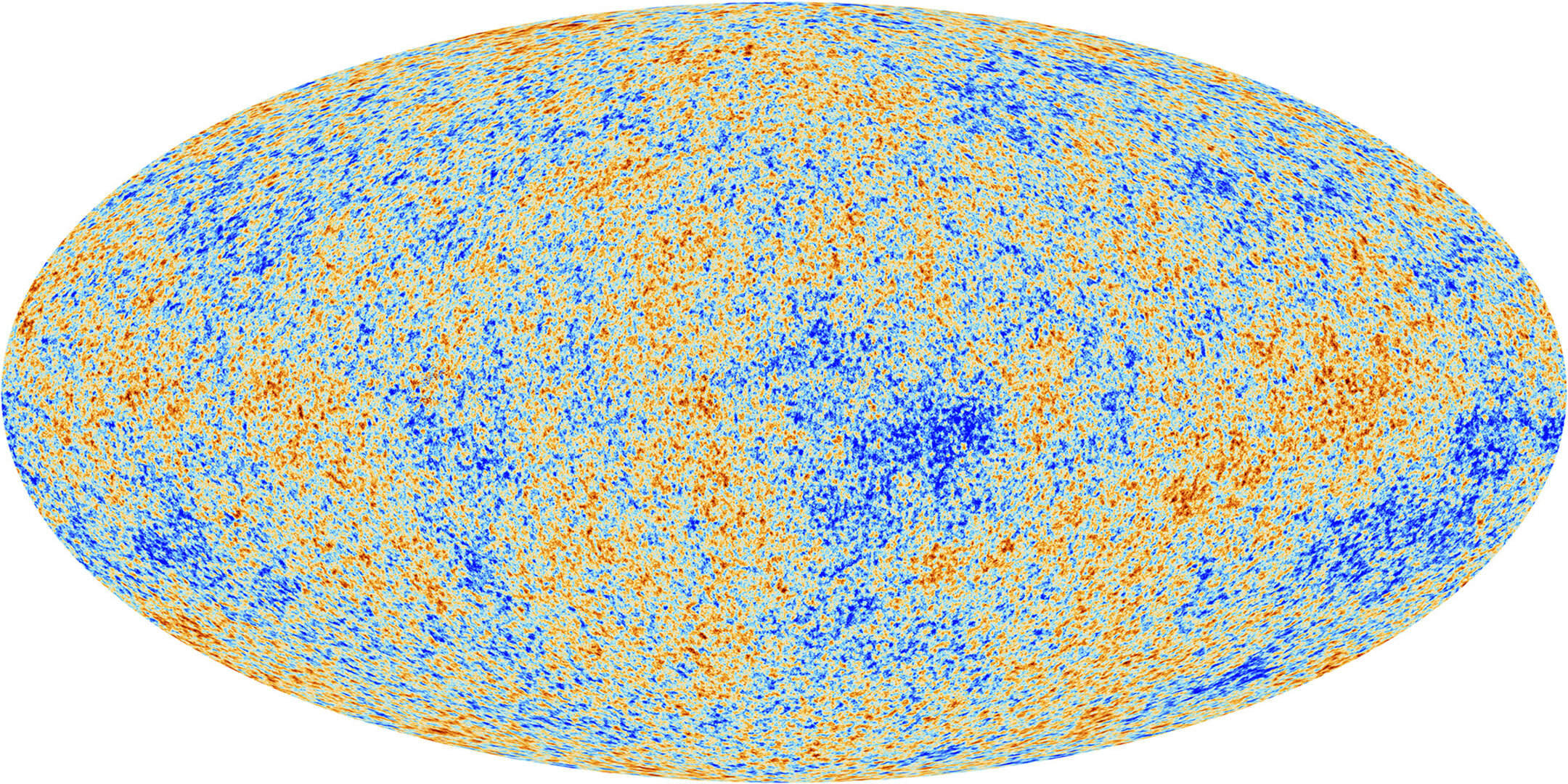

Put another way, we can say purely by analyzing the CMB that there is a reference frame in which it is about the same in all directions, and we are moving at 370 km/s with respect to that frame.
[deleted] t1_j26t72l wrote
Reply to comment by riotousgrowlz in Is the BF.7 mutation of Omicron less severe than variants? by Active_Bedroom_5495
[removed]
swampshark19 t1_j26t33z wrote
Reply to comment by Aseyhe in How fast does the Milky Way spin? How far does Earth move through space in a year? by Sabre-Tooth-Monkey
Thank you for educating me.
[deleted] t1_j26shoo wrote
Reply to comment by [deleted] in How fast does the Milky Way spin? How far does Earth move through space in a year? by Sabre-Tooth-Monkey
[removed]
Kantrh t1_j26scg5 wrote
Reply to comment by clocks212 in How fast does the Milky Way spin? How far does Earth move through space in a year? by Sabre-Tooth-Monkey
Possibly. According to this article https://www.forbes.com/sites/startswithabang/2020/02/15/ask-ethan-could-gravitational-waves-ever-cause-damage-on-earth.
bobtheblob6 t1_j26s5mx wrote
Reply to comment by Aseyhe in How fast does the Milky Way spin? How far does Earth move through space in a year? by Sabre-Tooth-Monkey
> the Sun is moving at about 370 km/s (1/800 the speed of light)
That's fascinating. One question that's always been in the back of my mind for some reason is "if speed can only be measured relative to something else, what if our 'absolute speed' in the universe is actually quite high (fast enough to cause time dilation), and everything around us in the known universe is also moving similarly, such that we have no indication of our actual movement, and no one has ever actually experienced something near the baseline, dilation-free flow of time?"
I guess there are reference points out there that we can use to show that is not the case!
[deleted] t1_j26rzpy wrote
Reply to comment by nearfar47 in In Parkinson disease, why doesn't the adrenal gland fill the dopamine deficiency? by Actual-Pumpkin1567
[removed]
duroo t1_j26y2rb wrote
Reply to comment by amaurea in How fast does the Milky Way spin? How far does Earth move through space in a year? by Sabre-Tooth-Monkey
Where does the speed of star collapse just before a supernova fit into this?