Recent comments in /f/askscience
[deleted] t1_j2fwzvq wrote
Reply to What is this extra strip in a RAT test for ? by humperty
[removed]
[deleted] t1_j2fwzkw wrote
[removed]
[deleted] t1_j2fvgup wrote
[removed]
menooby OP t1_j2fv0np wrote
Reply to comment by 0oSlytho0 in Do human antibodies bind to animal cells? I see that in ANA tests they use rat cells. are they transgenic mice? or just regular mice. by menooby
So it's a maybe but dk till we try
menooby OP t1_j2fuxup wrote
Reply to comment by iayork in Do human antibodies bind to animal cells? I see that in ANA tests they use rat cells. are they transgenic mice? or just regular mice. by menooby
Really?? Interesting. Thank you
[deleted] t1_j2fu56b wrote
Reply to comment by _AlreadyTaken_ in How much does the liquid magma of the Earth affect it's surface temperature? by tripperfunster
[removed]
[deleted] t1_j2ftszy wrote
Syzygy_Stardust t1_j2ft7f0 wrote
Reply to comment by BrokenImmersion in If fish accumulate mercury in the more toxic, methylmercury form, is it toxic to them? by XComhghall
The opposite. Because we live so long, we have more chances to absorb mercury than short-lived animals, which is worse for us. Obviously living longer is itself usually a preferred state, but it does cause situations like this where health issues arise over long periods of time.
Syzygy_Stardust t1_j2fsxld wrote
Reply to comment by Tabbeber in If fish accumulate mercury in the more toxic, methylmercury form, is it toxic to them? by XComhghall
Uh, as a sterile man, my concerns over mercury poisoning isn't toward my future babies, but my current brain.
mouse_8b t1_j2fstp7 wrote
Reply to comment by ajovialmolecule in Why is Mitochondrial Eve dated to 150-170,000 years go? by jayhovian
Mostly right. Realistically, her daughters and further lineage were all the same for a few generations until a new mutation occurred.
[deleted] t1_j2fsjww wrote
mouse_8b t1_j2fs6yz wrote
Reply to comment by S1rmunchalot in Why is Mitochondrial Eve dated to 150-170,000 years go? by jayhovian
Slight tweak to this, she was the only one whose mtDNA is still around. The other women of her generation would have also been passing on their mtDNA at the time. However, those other lines didn't make it to the present, for whatever reason.
Dubanx t1_j2frugo wrote
Reply to comment by BrokenImmersion in If fish accumulate mercury in the more toxic, methylmercury form, is it toxic to them? by XComhghall
While large animals eat more, they also eat foods that themselves have higher concentrations of mercury.
Krill eat mercury, have tiny amounts of mercury. Small fish eats many krill, bioaccumulate all the mercury from the krill. Small fish has relatively much more mercury in them than krill.
Medium fish eats many small fish. Medium fish bioaccumulates mercury from many small fish, it has even higher concentrations of mercury.
Large fish eats medium fish.
We eat the large fish, which has A LOT of mercury in it. Many times more mercury than the small animals do.
So it's not just the matter of we need more mercury and we eat more mercury but we tend to eat animals which themselves have relatively high levels of mercury. Then live long lives, giving said mercury a lot of time to build up.
I guess it's a bit redundant with the top of the food chain line.
MisterMaps t1_j2frd5p wrote
Reply to comment by [deleted] in Why is Mitochondrial Eve dated to 150-170,000 years go? by jayhovian
[deleted] t1_j2fr925 wrote
Reply to comment by sgarn in How did Rutherford arrive at gold foil as the best choice for his particle experiments? by Poltibolsa
[removed]
_AlreadyTaken_ t1_j2fp8nf wrote
Reply to comment by theCumCatcher in How much does the liquid magma of the Earth affect it's surface temperature? by tripperfunster
I even read that purple bacteria appear to be older than chlorophyll photosynthesis. So either absorbing green, the peak of the solar spectrum is TOO much energy (heat can disable the enzymes) or that part of the spectrum was already filled by organisms so the green ones took what was left.
Chlorophyll is also composed of many subunits that likely have been added as enhancing features over time, like energy transmitting antennae structures that funnel the photon energy to the reaction center.
I used to date a woman who was researching the dna structure of photosynthetic bacteria. :D
[deleted] t1_j2fom9k wrote
Reply to comment by Calth1405 in Why is Mitochondrial Eve dated to 150-170,000 years go? by jayhovian
[removed]
[deleted] t1_j2fo5iz wrote
Reply to comment by BioTechproject in If fish accumulate mercury in the more toxic, methylmercury form, is it toxic to them? by XComhghall
[removed]
theCumCatcher t1_j2fnzk5 wrote
Reply to comment by _AlreadyTaken_ in How much does the liquid magma of the Earth affect it's surface temperature? by tripperfunster
about the origin of photosynthesis.
I think there is something there.
if we look at the visible spectra of the sun,
https://www.sunlightinside.com/wp-content/uploads/2017/09/Sunlight_spectrum_Fiji_July.jpg
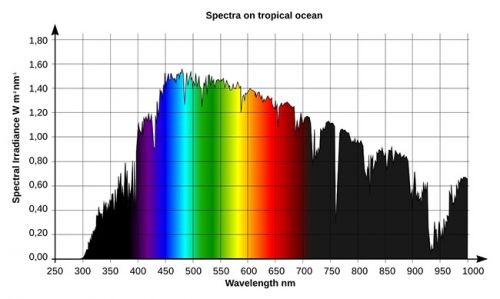
green and red are its largest components.
the protective pigments in leaves that reflect this red light (carotenoids) become visible when the chlorophil dies in the fall.
suspiciously, chlorophil reflects the remaining green part of the spectra almost perfectly

it could be the chlorophylls evolved from one of these pigments.
thats really neat
[deleted] t1_j2fngpd wrote
[removed]
_AlreadyTaken_ t1_j2fmtd4 wrote
Reply to comment by theCumCatcher in How much does the liquid magma of the Earth affect it's surface temperature? by tripperfunster
I'll toss out one more thing to think about. Life clearly evolved on earth before there was any ozone layer and ultraviolet light was bombarding the surface because it appeared before photosynthesis did so there was no free oxygen (or very very little) in the atmosphere to make ozone. So life can develop in spite of UV light, probably in water too deep for UV light to penetrate. Did photosynthesis evolve from mechanisms to protect against UV light in shallow water? Who knows...
sighthoundman t1_j2fmsxq wrote
Reply to comment by BrokenImmersion in If fish accumulate mercury in the more toxic, methylmercury form, is it toxic to them? by XComhghall
Sort of. Part of the reason that antibiotics work so well is that the amount to kill a bacterium is way smaller than the amount to kill a person.
The problem with mercury (and heavy metals in general) is that there's no way to flush them from the body.* We don't usually worry about salt buildup, because our bodies naturally dilute the salt and flush it out the kidneys. Things like that don't happen with the heavy metals.
* Yes, chelation therapy exists as a treatment for heavy metal poisoning. There are pretty strict guidelines, mostly because one of the side effects of chelation therapy can be death. "The therapy was a success but the patient died."
IndependentBoof t1_j2fx1t0 wrote
Reply to Are Educational Video Games Effective? by MEoDP1
It is too complicated to answer broadly, particularly since "educational video games" can include a wide range of software from something focused on specific learning outcomes (e.g. typing tutors) to games meant primarily to be entertainment but happen to have some historical information (e.g. Oregon Trail).
Generally speaking, the former will usually be more effective than the latter but I'd hesitate to paint with a broad brush. There is a lot of software out there that advertises itself as "educational" but doesn't follow the science of how we learn from multimedia.