Recent comments in /f/askscience
[deleted] t1_j4630us wrote
Reply to How do giraffes breathe? by NimishApte
[removed]
Sometimes_Stutters t1_j462q6b wrote
Reply to comment by [deleted] in where does epinephrine comes from? The one used for people with allergies because Google only says It comes from glands so I don't understand if it's donated or sintethized by other means. by SALAMI_21
I think the generally accepted definition of “by product”, especially in terms of production, is the secondary value that can be derived from primary value. A cows value is determined by its meat. They are economically feasible on that alone. Secondary value can be recovered from bone, skin, and organs but that value is still much less than the value of the meat. You couldn’t economically derive sufficient value from a cow with the secondary value alone.
[deleted] t1_j462e2u wrote
[deleted] t1_j4628aw wrote
Reply to comment by Chagrinnish in How do giraffes breathe? by NimishApte
[removed]
backfist1 t1_j461wmu wrote
Reply to comment by [deleted] in where does epinephrine comes from? The one used for people with allergies because Google only says It comes from glands so I don't understand if it's donated or sintethized by other means. by SALAMI_21
i work in an ICU, if anyone requests vegan EPI, i'm protesting my assignment and not treating that patient. also if you need EPI, you probably are too sick to even ask for anything.
[deleted] t1_j461v3w wrote
Bwyanfwanigan t1_j4617yr wrote
What is missing here is the practical part. You use a torque wrench to accomplish this. They have a part that let's you set the required torque, and then you turn the bolt with the torque wrench until the wrench clicks. Google torque wrench for an image. Older torque wrenches had just a pointer and scale and depended on the elasticity of the wrench handle to get the right torque. They were fairly inaccurate.
Theoretically undoing a torque bolt requires the same torque. Real world that depends on a lot of things...
Kevin_Uxbridge t1_j45zdp4 wrote
Reply to comment by Sharlinator in How do giraffes breathe? by NimishApte
Which is also why they can fly and do just fine at high altitudes where the oxygen gets thin. Amazing creatures, birds.
Chemputer t1_j45z8at wrote
Reply to comment by StingerAE in where does epinephrine comes from? The one used for people with allergies because Google only says It comes from glands so I don't understand if it's donated or sintethized by other means. by SALAMI_21
Yes, but he said derived from sugar cane, so you take cane sugar, sucrose, which can then be (either by your body or through industrial processes, usually using enzymes) split into fructose and glucose.
Like the other poster said, it's impurities in that from the cane sugar that would cause that, not the glucose itself. To put it mildly, if you're allergic to glucose, I don't think you could live. (Yes, the body can digest other forms of sugar for energy, but energy storage is done as glycogen which is a linked branching polymer of glucose molecules, and when it releases those from storage, it's glucose.)
The processes involved in extracting sucrose from cane sugar and then breaking it down into it's components, fructose and glucose, and then purifying just the glucose are likely not set up to purify it to 99% purity. Obviously, if they did have glucose from cane sugar that was purified to a significant enough degree (say 99.99% or LCMS grade), they'd get no allergic reaction to it unless it was nocebo/psychosomatic.
I mean, it's like saying you're allergic to the letter L in light but not in any other word. It's ridiculous. The letter L is the letter L, glucose is glucose, therefore glucose cannot be responsible for their allergy.
[deleted] t1_j45z4v0 wrote
Reply to How do giraffes breathe? by NimishApte
[removed]
W0tzup t1_j45yiny wrote
Torque = force x radius.
If the force applied is constant but say the wrench is longer, then the torque generated will be more, and vice versa.
When you use a wrench with a preset amount of torque, it tightens the screw to that torque value and in order to loosen it up you will need to generate a minimum amount of that torque in the opposite direction.
The purpose of tightening screws/fittings to a specific torque value is so the thread does not get damaged; especially when you need to undo/redo them often.
pow3llmorgan t1_j45xly7 wrote
Reply to comment by Vazmanian_Devil in How do giraffes breathe? by NimishApte
They also have a pressure regulator on their carotid artery (jugular?), which allows them to lower their head to drink.
[deleted] t1_j45x1l0 wrote
[deleted] t1_j45wvq9 wrote
abat6294 t1_j45txun wrote
Yes, you described it nearly perfectly. I'd make two corrections:
- In reality, the torque required to loosen a fastener doesn't always equal the torque applied when it was tightened especially if a lot of time has passed. But if you immediately loosen a fastener after tightening, it should be about the same.
>In order to have a screw torqued to 7 in-lbs, do I apply a load of 1 pound 7 inches away until it no longer rotates?
- I think this definition works, but when applied in reality it's more like: Rotate the screw until 7 in-lbs of torque is reached. Because as you know, more and more torque is required to spin a fastener the tighter it gets. When it's loose, you can only apply torque up until it spins.
So if a screw spins with 5 in-lbs of torque, then you simply can't apply 7 in-lbs - it moves before 7 is reached.
Scuka1 t1_j45thhk wrote
If a screw is torqued to 7 in-lbs torque, that means that, if you used a wrench 7 inches long, and pushed with 1 lbs of force at the end of that wrench, you'd achieve that torque.
By tightening with different torque, you're achieving a larger preload on the bolt.
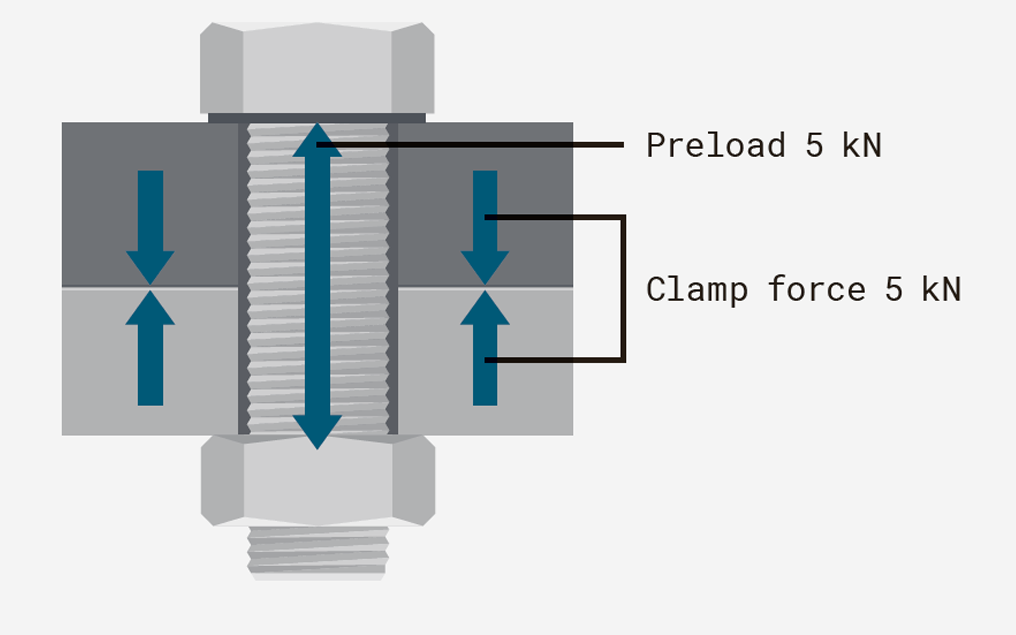
If you look at that picture, the bolt acts like a spring. Bolt head and nut are in fixed position (to simplify), but as you tighten the bolt, the bolt threads "travel" down the nut so the bold stretches just like a spring would. The elastic force of that stretch keeps the two plates together. The tighter you turn the bolt, the more you stretch it, the more preload you get, and ultimately the more clamping force there is.
die_kuestenwache t1_j45t9md wrote
The more you tighten a screw, the more "force" it takes to tighten it further. Since tightening a screw is a rotational movement, what you're interested in is torque, not force. If you tighten it to a specific torque, this means you stop tightening once the torque necessary to tighten it further would exceed your limit. Reasons to only tighten to a certain torque might be that further tightening could deform whatever you are fixing with the screw or it might snap the head if you go too far beyond.
[deleted] t1_j45t3fl wrote
Reply to How do giraffes breathe? by NimishApte
[removed]
[deleted] t1_j45ss9u wrote
[removed]
Current-Ad6521 t1_j45shpi wrote
Reply to When nerve damage occurs, where is the pain perceived? at the site of damage or at the end of the nerve? by menooby
What you feel is situational dependent, and most areas of the body to not have the acuity for there to be a difference. What I mean by this is that the majority of the body is not sensitive enough for you to tell exactly where you are feeling something, and most nerves are so small that it is well below the threshold for being able to tell where the sensation is coming from exactly. There are also different types of mechanoreceptors that perceive touch, vibration, pressure, etc. differently and occur in different amounts over the body, so there is no one size all fits answer for perception related questions. In many cases you wouldn't feel anything, it would just be numb. The pain does physically "happen" in the pain receptors which are at the end of the nerves, though our sensation and perception is not fine tuned enough for us to feel a difference.
For example, if you put two pins next to each other on someones fingers with their eyes closed they would feel that there are two pins. The fingers have high acuity because of the type of mechanoreceptor + there are many small receptors and a large amount of brain dedicated to fingers. If you put two pins next to each other on someones back, they will feel as if there is only one. The nerve anatomy is not fine tuned enough on your back to be able to tell that there are two pins, and only one receptor is activated. Now imagine you put two microscopic pins a fraction of a millimeter away from each other. You wouldn't feel two different pins because the distance is so small, which is how nerves usually are. There are bigger nerves, like the ulnar nerve aka funny bone where you can feel more localized pain though it still is not that obvious where you are feeling the pain in terms of ending vs stem.
StingerAE t1_j45sg1f wrote
Reply to comment by Kriggy_ in where does epinephrine comes from? The one used for people with allergies because Google only says It comes from glands so I don't understand if it's donated or sintethized by other means. by SALAMI_21
Isn't cane sugar sucrose anyway?
[deleted] t1_j45rwwt wrote
Reply to comment by [deleted] in How do we know that dark matter isn't just ordinary matter our instruments can't detect? by jmite
[removed]
StingerAE t1_j463b3t wrote
Reply to comment by Chemputer in where does epinephrine comes from? The one used for people with allergies because Google only says It comes from glands so I don't understand if it's donated or sintethized by other means. by SALAMI_21
Yeah, I realise it is ridiculous. I just want sure is they had understood and meant what they said. Why would anyone source glucose that way? The fact sucrose from sugar cane would need processing and into glucose is the craziest part.