Recent comments in /f/explainlikeimfive
2minutespastmidnight t1_j292rcb wrote
Reply to eli5: If Lie Detector tests are highly accurate, why are they not used in court? by NemesisSenpai
Here is a copy/paste from an earlier submission of mine regarding the polygraph. I didn’t change any of the formatting, so you’ll see that my answer was originally meant for someone else. However, these answers are still relevant to your question.
I submitted a paper in a college about whether the polygraph should be used in investigations at all for a forensic criminalistics course. There's a rather long history with respect to the device. You probably know the courts have ruled that, in general, the results from a polygraph are not admissible in court. This dates back to the outcome of a 1923 D.C. Circuit of Appeals Court case known as Frye v. United States where it was debated whether the polygraph met the standard of general acceptance (accepted within the "relevant scientific community").
I have no formal experience with the polygraph. This was just an assignment for a class. The device itself measures physiological responses that are often "associated" with deception. These responses include your heart rate, your breathing patterns, any sweating, systolic blood pressure, and sometimes a voice-stress analyzer.
You asked if polygraph tests are reliable. In my opinion, they are "reliable" to the degree of the relationship between the examiner administering the questions and the person undergoing the test; it's more of a game of psychological dominance on the part of the examiner. This goes to your second question on whether it is easy to "fake" it. It's not so much about whether it's easy to fake, but rather your perception of the device as well as your reaction to the questions being asked. This moves into your third question. Polygraph tests are used to measure your responses between two categories of questions: control questions and relevant questions. There are neutral questions as well that serve to create a baseline response such as "Is your first name ____?"
Control questions are questions where pretty much none of us could answer with 100% honesty such as "Have you ever told a lie to your parents?" or "Did you ever cheat on a test in school?". The examiner knows this and will assume you're not telling the truth. This is done by design. These questions aren't the ones that matter.
Next, you'll be asked a relevant question in which the examiner wants to get VERY specific on a certain subject such as with the use of illegal drugs or whether you knowingly omitted anything on your background questionnaire. Your responses to these questions are measured against your responses to your control questions. This is what helps to determine your "truthfulness".
That's pretty much how they work.
D3V1LS_L3TTUC3 t1_j292pqq wrote
Reply to comment by grumblingduke in ELI5: What do the words "left" and "right" in world politics? by UltimateGamingTechie
Notice how the most extreme example of “far left” is people killing a relatively small number of wealth hoarders with the intention of redistributing wealth to society, meanwhile “far right” is the literal genocide of hundreds of thousands (if not millions) of innocent people
D3V1LS_L3TTUC3 t1_j292g80 wrote
Reply to comment by Ohmyfrogginbeak in ELI5: What do the words "left" and "right" in world politics? by UltimateGamingTechie
I mean. Given the way that right wingers tend to restrict the rights/liberties of anyone who isn’t a straight cisgendered able-bodied/minded white man.. I would definitely not say conservatives focus on “individual liberties”
Derikoopa OP t1_j291ybw wrote
Reply to comment by Just_Jen_1 in eli5: Why couldn't a country in debt mint a coin of immense value and use it to pay off the debt? by Derikoopa
This makes sense in terms of a currency backed by the gold standard, but since that doesn't really exist anymore is it still relevant?
grumblingduke t1_j2915mb wrote
"Left" and "right" are fairly vague terms, used to split people into convenient political groupings. They are the continental-European versions, compared with the more British/American "progressive," "liberal" and "conservative" terms. They are all a bit vague due to the different political landscapes in different countries and at different times, and the terms (particularly "liberal") can have very different meanings in different places.
Roughly speaking, and generalising horribly:
-
left-leaning people/progressives feel that power structures and social hierarchies are a bad thing, and that the role of society (via government) should be to remove them,
-
right-leaning people/conservatives feel that power structures and social hierarchies are a good thing, and that the role of society (via government) should be to protect them.
-
centrists/liberals may feel either way about power structures and social hierarchies, but don't think the government should interfere.
Then you have groups like anarchists and libertarians, and a few others, who tend to line up somewhere with the above but might disagree on the specifics.
With both left and right you get "centre-" "hard-" and "far-" etc. depending on how extreme they take their views. Far-right people and governments tend to be in favour of use of direct force to impose power structures (to the extremes of the 1930s-40s German Government which systematically killed millions of people who didn't fit in their ideal society), while far-left people and governments can do the same to abolish power structures (e.g. the 1920s Russian Government which killed a lot of nobility and religious leaders who were part of the existing power structures).
"Left" and "right" is mostly relative, though. A "left-wing" group in one country might have similar views to a "right-wing" group in another country, depending on where the "centre" is.
flippythemaster t1_j290t5d wrote
Reply to comment by Aussie_Mo_Bro in eli5: If Lie Detector tests are highly accurate, why are they not used in court? by NemesisSenpai
He also was really into bondage. The lasso of truth makes sense now
Bird_Brain4101112 t1_j290m9g wrote
Reply to ELI5: By using Medical Science, we are practically denying natural selection. How can it affect us in the future? by No_Victory_1611
It can be said we’ve evolved to adapt to the type of society we are now. If you were a hunter, bad eyesight could get you killed. But we no longer need to hunt our own food to stay fed. But you do need to be able to see so you don’t get creamed by an oncoming car.
[deleted] t1_j290d44 wrote
[removed]
Broyster OP t1_j2907wh wrote
Reply to comment by Scuka1 in eli5: What are the subtypes of games? by Broyster
I don't have Steam or a pc. I have my phone, the categories on it aren't diverse enough to allow me to reference them casually in conversation. That being said, games are a huge part of my personality. I find it difficult to talk with people about them when I don't feel confident in my understanding of the definitions.
[deleted] t1_j2907d9 wrote
DHaze27 t1_j2905l8 wrote
Reply to comment by prustage in ELI5 How do animals that swim/fly in complex formations do it? by TheBaddestPatsy
Agreed. One of the common theories is that large migratory birds (geese, swan, etc) fly in formation for the aerodynamic advantage...drafting like cars in a race. The leader will also "rotate" through to allow individual birds to rest. They're able to fly in the correct direction because birds are sensitive to the earth's magnetic fields
djddanman t1_j28zuhy wrote
Reply to comment by Jkei in ELI5: Why are medical doctors commonly referred to as "doctors" over other types of doctors? by whatwouldultralorddo
Some of my undergrad professors were tenured but still went by doctor
Foddor088outside OP t1_j28zgy6 wrote
Reply to comment by A_Garbage_Truck in ELi5: who was Karl Marx and what were his theories? by Foddor088outside
Touché
r2k-in-the-vortex t1_j28zbrk wrote
Reply to eli5: Why couldn't a country in debt mint a coin of immense value and use it to pay off the debt? by Derikoopa
Printing money doesn't create value, it merely redistributes it. So to a limit printing money works as a tax on owning currency, but of course if that tax burden is too high then people will rather not own that currency and strive to exchange it for anything else they can. That's how you get hyperinflation and you can't print yourself out of that one because there is no value left to redistribute.
Scuka1 t1_j28z7dg wrote
Reply to comment by Broyster in eli5: What are the subtypes of games? by Broyster
Why do you need that? It's a pretty weird question to ask.
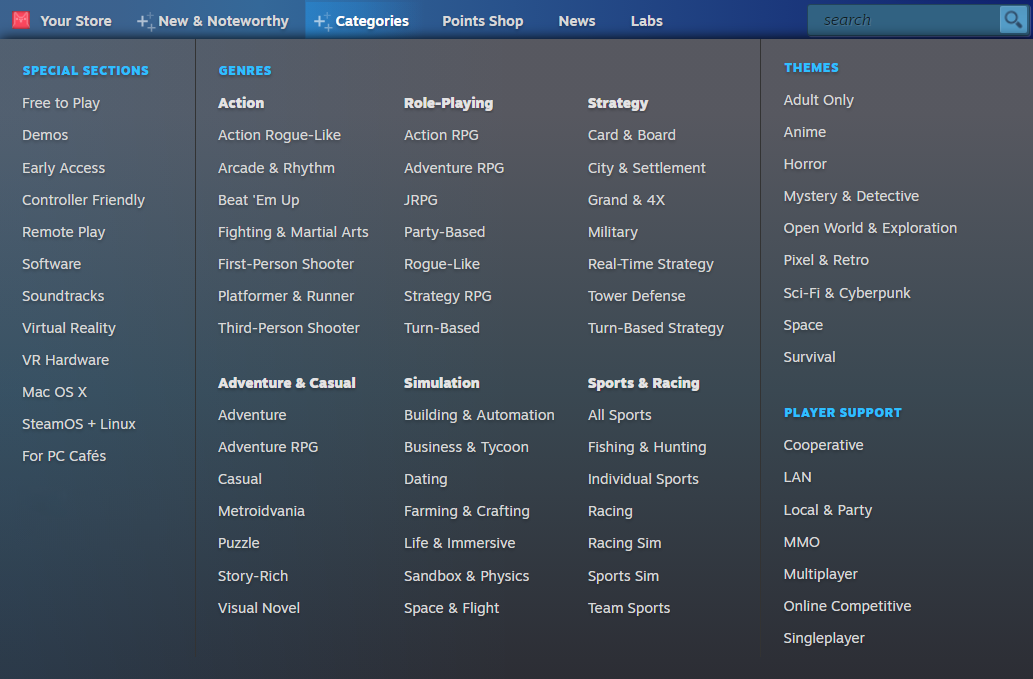
There aren't any strictly defined genres and many games cannot be confined to a single genre because they have elements of multiple genres. The genres are just rough descriptions of games, not exact science. There isn't any universal consensus as to what constitutes a particular genre.
But to get the rough idea, just open any game distribution service (such as Steam), and see what kind of division they use.
nim_opet t1_j28z2dn wrote
Reply to ELI5: By using Medical Science, we are practically denying natural selection. How can it affect us in the future? by No_Victory_1611
Humans left natural selection somewhere like 1.5 million years ago when they started cooking food and feeding the weak and sick family members. Not to mention things like agriculture….
grumblingduke t1_j28yz6x wrote
Reply to comment by Spiritual_Jaguar4685 in ELi5: who was Karl Marx and what were his theories? by Foddor088outside
> I'll just add that Marx lived in the mid-1800s, in Germany,
Worth noting that in his 20s he was exiled from Prussia at the request of the Russian monarchy (for his articles critical of them), lived in Paris from 1843-1845 until the Prussian Government got him expelled from France and had his radial German-language (but Paris-based) newspaper shut down. He lived in Brussels until 1848, when he was expelled on allegations that he had helped fund Belgian workers planning a revolution, and he bounced between a post-revolution France and Cologne, until he was kicked out of both, moving to London in 1849, aged 30, where he lived until his death.
Marx's most famous works (Das Kapital and The Communist Manifesto) were both written in London.
[deleted] t1_j28ytds wrote
[removed]
johnn48 t1_j28yl7q wrote
Reply to ELI5: By using Medical Science, we are practically denying natural selection. How can it affect us in the future? by No_Victory_1611
The ability to overcome one disadvantage does not guarantee your ability to overcome other difficulties. I’m nearsighted, wear glasses, thus am able to see far. I’m 72 suffered a stroke am hemiplegic, as a result limited mobility so I’m housebound. So I’ve not conquered Natural Selection but merely mitigated its effects.
utopianbask t1_j28ykcj wrote
Broadly speaking:
Far left - Communist
Left - Liberal minded
Centre - a mix between liberal and conservative. Usually quite pragmatic.
Right - Conservative minded
Far right - Fascist
This isn't a definitive guide, most people are more mixed and complicated. But broadly speaking, this is what people mean when they use those terms.
A_Garbage_Truck t1_j28yef7 wrote
Reply to comment by Foddor088outside in ELi5: who was Karl Marx and what were his theories? by Foddor088outside
your question was , who was the man, and this has been answered.
i cannot give you a legitimate answer on this that wouldnt get political, so in all due respect i'd rather not.
mixer99 t1_j28yd2m wrote
Almost all the food we eat today is the result of hybridization (seafood being the main exception). So with pears, the grainy texture is either something someone wanted, or attempts to breed it out had a negative effect on something else (for example, maybe pears with smoother flesh had a shorter storage life).
r2k-in-the-vortex t1_j28y8gh wrote
People say they want to buy or sell certain financial instrument for certain value, and the exchange matches up the trades while collecting its fees. Simple in principle. Also, an exchange doesn't just trade any stock, its picky about what it lists and what it doesn't. If you wish to trade non-listed stock you got to go find your own trade partners.
Luckbot t1_j28y2dx wrote
Reply to comment by Foddor088outside in ELi5: who was Karl Marx and what were his theories? by Foddor088outside
"Once the working class realizes it's being exploited"
But the revolution he predicted came, and it turned out way different than he expected (the russian revolution)
[deleted] t1_j293ckf wrote
Reply to eli5: If Lie Detector tests are highly accurate, why are they not used in court? by NemesisSenpai
[removed]