Recent comments in /f/explainlikeimfive
grumblyoldman t1_j5i9cuw wrote
Reply to comment by Iamapartofthisworld in ELI5: How come some commercials will mention the competition by name but others use generic terms like “leading brand”? by OmarBarksdale
Now I kinda want to tour a Michelob brewery to see how it's made. But at the same time, I think that might be a bad idea.
[deleted] t1_j5hzui5 wrote
Iamapartofthisworld t1_j5hzbub wrote
Reply to comment by Dirty_Quesadilla in ELI5: How come some commercials will mention the competition by name but others use generic terms like “leading brand”? by OmarBarksdale
TIL drinking Michelob turns you into a cannibal
thisusedyet t1_j5hykwm wrote
Reply to comment by 680228 in ELI5: How come some commercials will mention the competition by name but others use generic terms like “leading brand”? by OmarBarksdale
As you can see, even supervillians are afraid of lawyers
GoodGoodGoody t1_j5hycr5 wrote
Reply to comment by WeDriftEternal in ELI5: How come some commercials will mention the competition by name but others use generic terms like “leading brand”? by OmarBarksdale
Ok. Noted.
Anyhow, to expand in Trump and Putin’s practice if never properly identifying or acknowledging political foes…
680228 t1_j5hxq6x wrote
Reply to ELI5: How come some commercials will mention the competition by name but others use generic terms like “leading brand”? by OmarBarksdale
Companies that use "leading brand" or "other products" are simply more risk averse (they don't want to get sued). Companies that name their competitor are not afraid of being sued. This could either be because they have proof of their superiority claim, or they are comfortable with the legal risk.
All large companies that advertise have legal counsel (sometimes external, sometimes on staff). Generally, a lawyer will assess the risk of a claim and advise the decision makers in the marketing department of the risk level - high, medium or low. A high risk claim has a higher likelihood of provoking legal action from a competitor, and has to be signed off by a more senior director or VP. However, if they have facts and data to back up the claim, and can defend it in court, they can run with it.
Networks will not allow commercials with superiority claims to air unless the advertiser submits substantiation backing up the claim. Local stations are less strict.
I'm an advertising producer, and I've worked with large advertisers that do the "leading brand" thing. Any time we did a side-by-side efficacy demonstration, I had to sign an affidavit that the demonstration was real, shot and edited without special effects. Companies do sue each other, and have even gone as far as sending a subpoena to view raw camera footage from the commercial shoot.
WeDriftEternal t1_j5hwrkp wrote
Reply to comment by GoodGoodGoody in ELI5: How come some commercials will mention the competition by name but others use generic terms like “leading brand”? by OmarBarksdale
No. Its just a bad comparison that should not be used.
GoodGoodGoody t1_j5hwplq wrote
Reply to comment by WeDriftEternal in ELI5: How come some commercials will mention the competition by name but others use generic terms like “leading brand”? by OmarBarksdale
Which is why I said it made them look silly. Trump and Putin are marketers. But the political product is different from soap and cars.
WeDriftEternal t1_j5hv7kc wrote
Reply to comment by GoodGoodGoody in ELI5: How come some commercials will mention the competition by name but others use generic terms like “leading brand”? by OmarBarksdale
I don't think this is at all a good comparison. Politics and especially highly unusual people such as the ones you mentioned don't necessarily follow the same rules as generic branding and advertising concepts
GoodGoodGoody t1_j5hv0r3 wrote
Reply to comment by WeDriftEternal in ELI5: How come some commercials will mention the competition by name but others use generic terms like “leading brand”? by OmarBarksdale
You see this with Putin and Trump. They play the part of ‘industry leader’ by never using opponents real names. This of course only makes them look insecure and frightened.
Dirty_Quesadilla t1_j5hq2b9 wrote
Reply to comment by WeDriftEternal in ELI5: How come some commercials will mention the competition by name but others use generic terms like “leading brand”? by OmarBarksdale
I think anyone who drinks Michelob is likely a cannibal.
WeDriftEternal t1_j5hmp0k wrote
Reply to ELI5: How come some commercials will mention the competition by name but others use generic terms like “leading brand”? by OmarBarksdale
No legal issues in just making a comparison or mentioning another brand, as long as you don't say intentionally damaging and false claims, like saying Michelob makes you a cannibal. Sometimes they simply don't want to advertise their competition.
A side note though, if you are the category leader, like say Coke over Pepsi -- you NEVER, ever mention your competitor. You are the champ, they are nothing to you, you don't mention them,
If you're not the cateogry leader, you can and often do call out others in the industry to say why your product is better than them. That is, Pepsi will say its better than coke, but Coke will never mention pepsi
Academic_Party_4725 t1_j5gwgcl wrote
Reply to comment by IAmXlxx in ELI5 Are facial expressions and reactions like laughing learned, or do all humans do it? by David1192
Facts.
Diogeneselcinico42 t1_j5goyt5 wrote
Reply to ELI5 Are facial expressions and reactions like laughing learned, or do all humans do it? by David1192
It's mostly genetic. Body language and facial expressions are largely programmed into our DNA and we are born with the knowledge of how to perform them and interpret them. This is unlike verbal language, which is 100% learned.
Have you ever noticed that no matter who the person is on this Earth, whether they be Chinese, African, Native American, European, etc, you can kind of tell if they are happy or sad from a picture or drawing without ever needing to learn anything about their language? This is pretty remarkable. We have a mechanism of communication amongst humans that is universal and belongs to us as a species.
Dogs and other social mammals also have body language cues they use to communicate with one another. You can look up a handbook of all the various dog body language meanings. Tail wagging indicates they are happy or anticipatory, raised teeth and ears back indicates aggression, etc.
LeviathanGank t1_j5gicij wrote
Reply to comment by Remarkable-Owl2034 in ELI5 Are facial expressions and reactions like laughing learned, or do all humans do it? by David1192
yup my baby laughs when having fun but also laughs like a mad man when we laugh, i think its both natural and copy mechanics..
Human_Ballistics_Gel t1_j5geon2 wrote
The same way your ears hear more than one frequency.
The sounds around us are composed of a complex range of frequencies mixed together. Those mixed together sounds impact your eardrum causing it to vibrate and you hear it.
If you were able to make your eardrum vibrate the same exact way, and amplify the movement, it would emit the same sound you just heard.
Electronic speakers and microphones are the same.
Very simplified, microphones are just speakers. Electricity applied to a speaker makes it move.
This works in reverse too, moving or vibrating a speaker manually makes tiny bits of electricity that match that movement or vibration.
The complex pattern of sound hitting a (mic / speaker) and the resulting complex pattern of electricity it makes can be recorded.
Then you amplify and play back that pattern of electricity to a much larger and louder mic/speaker and that same sound is reproduced
Your ears or a microphone actually move very very little with sound. So you can hear low and high frequencies at the same time.
Similarly most (not all) headphones are just a single tiny speaker that do a decent job of reproducing most frequencies that humans can hear. They can do this because they don’t have to move very much (and be very loud). Again, like my “your ears in reverse” example.
However large speakers have to move a LOT to make very loud low frequency sound. If a speaker is moving an inch back and forth 500 times a second, ALSO trying to make it vibrate a fraction of a millimeter’s distance, 20,000 times per second at the same time doesn’t sound very good.
So to make loud amplified sound, sound better they divide up the work. Small very tight speakers (tweeters) are good at making high pitched sounds. (But can’t move enough to make loud low frequency sounds)
Large loose speakers (woofers) that can move a lot are very good at making low frequency sounds. (But are not tight enough to make loud high frequency sounds)
Inside a speaker is something called a crossover that divides up the electric pattern such that high frequencies go to the tweeter and low frequencies go to the woofer.
That way you can more accurately reproduce loud sound at much higher volume levels.
IAmXlxx t1_j5g020q wrote
Reply to ELI5 Are facial expressions and reactions like laughing learned, or do all humans do it? by David1192
Paul Ekman is a psychologist famous for his research on body language/nonverbal communication. He found that there are at least several "universal" emotions and corresponding facial expressions, like anger, sadness, joy, disgust, etc. However, there are thousands of expressions our facial muscles can produce, and it's probable that we learn at least a few of them from our environments and cultures.
[deleted] t1_j5fxqj8 wrote
ChillTBH t1_j5fvqj0 wrote
Reply to ELI5 Are facial expressions and reactions like laughing learned, or do all humans do it? by David1192
It's a mixture I think. There's a tribe which Malcolm gladwell talked about in his book talking to strangers which expressed themselves very differently facially to most in the west.
Jazzkidscoins t1_j5fuboi wrote
Reply to ELI5 Are facial expressions and reactions like laughing learned, or do all humans do it? by David1192
Gorillas laugh, they probably didn’t learn that from humans. However some facial expressions are learned. In India the way they move their heads when talking is almost a language in itself. These head movements can vary region to region.
M8asonmiller t1_j5fo350 wrote
Reply to ELI5 Are facial expressions and reactions like laughing learned, or do all humans do it? by David1192
Blind people naturally smile and deaf people know how to laugh, so it's most likely that these are inherent behaviors, not learned.
BeneficialWarrant t1_j5fm1b3 wrote
All the speaker does is move forwards and backwards. Its a linear motor.
If you take 2 signals (say 2 simple frequencies) and add them together, you get a new, combined signal.
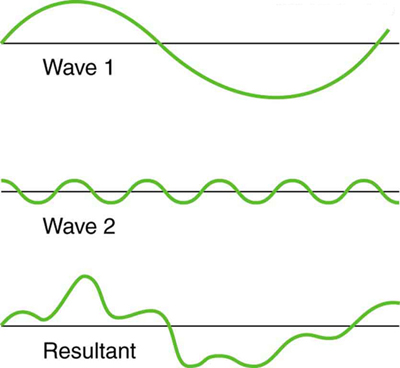
The above combined signal is created from 2 simple sine waves with a high and a low frequency. If the speaker moves in the combined pattern, it will create waves of air pressure which will stimulate 2 different length hair cells in your cochlea.
Tanagrabelle t1_j5fjvv9 wrote
Reply to ELI5 Are facial expressions and reactions like laughing learned, or do all humans do it? by David1192
The hardest part is to track down actual pictures, information, and footage of those who were raised from infancy by animals. I have this vague idea that, without reinforcement from human faces around them, the muscles for smiling will atrophy.
Rugfiend t1_j5fcxa6 wrote
Imagine dropping a single pebble into a puddle. Now imagine a handful. Now record that clip and play it back. Now just translate that to sound waves - the recording encodes the ripples, the speaker merely reproduces it.
ExpressionTop5357 t1_j5ic0js wrote
Reply to comment by Dirty_Quesadilla in ELI5: How come some commercials will mention the competition by name but others use generic terms like “leading brand”? by OmarBarksdale
If I had awards to give, this comment would get one.