Recent comments in /f/explainlikeimfive
WinBarr86 t1_j6dws6k wrote
Reply to comment by ToxiClay in ELI5- what is the difference between a liquid and a fluid? by stinkybuttttt
An amorphous material has a liquid atomic structure but does not flow as a fluid.
That is the litteral definition of amorphous materials.
They are classified as a solid liquid or non fluid liquid.
Skusci t1_j6dwroz wrote
Reply to comment by pulsebait in eli5 why is the age of a car determined by it's mileage by pulsebait
Try and propose a different metric. Guarantee it's basically impossible to standardize.
We use mileage cause it's all we got.
Bay_Brah t1_j6dwp99 wrote
Reply to comment by aminy23 in eli5: home heating/cooling types by [deleted]
Did you write all that out? Thank you so much. I am saving this for when I buy a house.
Shifter93 t1_j6dwn8d wrote
Reply to comment by WinBarr86 in ELI5- what is the difference between a liquid and a fluid? by stinkybuttttt
dude, you keep linking the same incorrect definition over and over again. whats more, its literally the only source i can find that calls amorphous solids liquids on the entire internet. every single other website correctly calls them solids and you chose to run with the single incorrect one.
ShankThatSnitch t1_j6dwmn4 wrote
Reply to ELi5 : If you can access a website, why cant you steal the source code and make a 1:1 copy of it? by 13lettersinhere
Some you can and some you can't. It depends on how the site was built.
The Raw HTML, CSS, and Javascript is visible, and for older websties, that may be all you need. But if a site is made using C#/.NET, PHP, jQuery, Angular, React...etc These things get compiled(converted) from those languages on the server side, and converted into the stuff you see. You can see the end result, but not what goes on behind the closed doors.
So you could steal the code and make something appear the same, but it won't function.
WinBarr86 t1_j6dwfqt wrote
Reply to comment by c4pta1n1 in ELI5- what is the difference between a liquid and a fluid? by stinkybuttttt
No they are not liquids.
Amorphous solids are liquid solids. Liquids that are not fluid.
amorphous solid is a liquid that does not flow: its atomic structure is disordered like that of a liquid but it is rigid and holds its shape like a solid.
PointlessGeolocation t1_j6dwfc4 wrote
Reply to comment by ashjafaree in ELI5: How do jammers (cellphone etc.) work? Could one block a direct connection to a router? by kenda1l
I used to have one. It wrecked my 2G/3G but my wifi was fine. Idk what else to say
Skusci t1_j6dwcqr wrote
Reply to comment by Plasdfgjs in ELI5- what is the difference between a liquid and a fluid? by stinkybuttttt
Gas not glass.
aminy23 t1_j6dw4sw wrote
Reply to eli5: home heating/cooling types by [deleted]
> forced air
It has as a fan and blows heat.
If you have a fireplace or radiator, it just gets hot and doesn't actually blow it.
> a furnace
Burns something for heat. This can be natural gas which is piped to the the house, or:
> liquid propane vs heating oil
Propane is an explosive gas. It burns up in a couple seconds.
Oil is not explosive, it burns very slowly and releases more heat, but often produces more smoke.
Oil is safer and easier to haul. Theoretically it might freeze and become buttery in very cold conditions.
> "central"
One unit for multiple rooms. You have ducts (big pipes) that can blow hot air through multiple rooms.
> geothermal
If you place a big container of water in the freezer, it might take days to freeze. The outside can freeze while the inside is warm.
If you have a big mountain, it heats up slightly in the day, and cools down slowly at night. But because it's so different the temperature stays pretty constant. Sometimes it's even constant throughout the year.
If you did a hole that's deep enough, it just keeps getting warmer underground. There's so much dirt that it weighs a lot and won't freeze easily. Eventually if you go super deep your get hot lava.
With geothermal you dig a hole or trench that's deep and run a water pipe through it. When you put cold water in the pipe, the heat deep in the ground will heat it up so you get warm/hot water on the other end.
> boilers
A fire or electric heat that boils water. These are used for big buildings.
Instead of running ducts with hot air.
They run pipes with steam or boiling water.
> Radiator
The hot water from a boiler flows through it and makes it hot. There's no fan, and sometimes they don't even use electricity.
https://upload.wikimedia.org/wikipedia/commons/0/02/Household_radiator.jpg
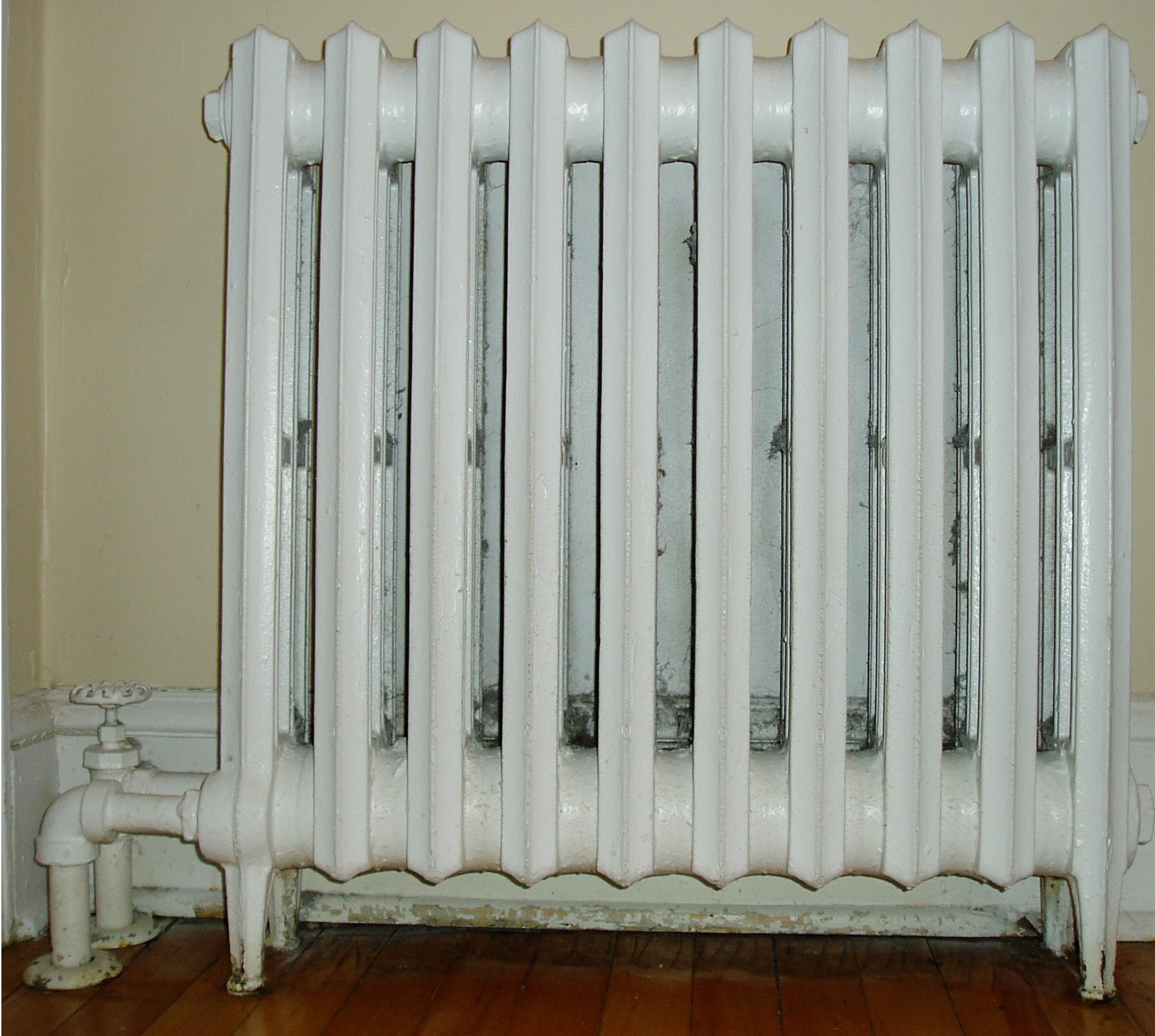
It just gets hot, and as a result sometimes one side of the room is hot and the other is cold.
If a fan is added it can be a hydronic system and it evens out the temperature better. With a hydronic system, you can also pump cold water and use it as an A/C.
> heat pump
An air conditioner has two ends. One blows hot air, one blows cold air.
Normally you want the cold air to blow inside, and the hot air to blow outside.
It turns out if you run an air conditioner backwards, it will blow cold air outside, and hot air inside. This makes it surprisingly effective as a heater.
An A/C actually produces more heat than cold.
Let's say it's 10 degrees outside. If you cool the outside part of the A/C to zero degrees.
The 10 degrees air actually warms it up from zero to ten degrees.
Because of this, a heat pump can actually grab little bits of heat from outside and it's one of the most energy efficient ways to heat a house.
> mini splits
An A/C has a hot side, and a cold side.
With a mini split you leave the hot side outside, and the cold side inside.
These are connected with pipes instead of ducts.
Pipes end up being more efficient than ducts.
With a central system you have one system for the whole house, or 2-3 zones in a house.
With a mini-split you can have one system for each room.
These systems can each have their own outdoor box, or they can share a big outdoor box.
Mini-splits are especially easy to run backwards and use as a heat pump.
By heating/cooling just the rooms you need you can save a lot of power vs heating/cooling your whole house.
> baseboard
A heater on the bottom of a wall: https://images.thdstatic.com/productImages/a8027bb7-12b0-4200-93c8-260d3ff7c00f/svn/whites-cadet-baseboard-heaters-ebhn1500w-4f_600.jpg
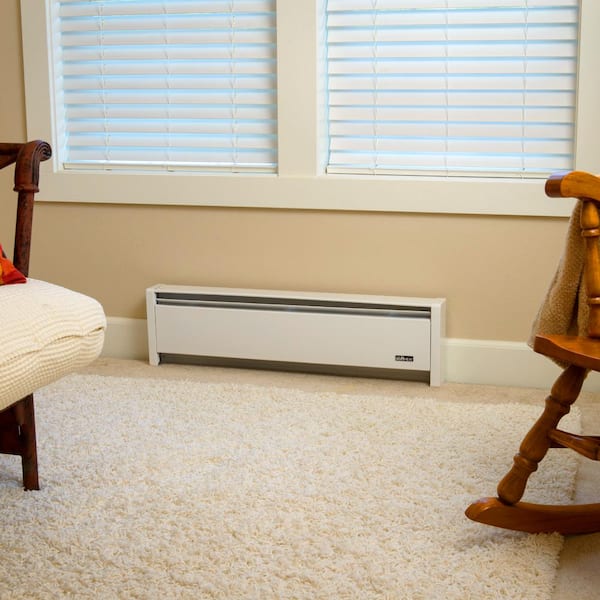
> window units
Mounted in a window. Typically these are air conditioners, but some can do heat as well.
Since they're in a window they can blow the hot air outside the window, and the cold air inside.
They don't need any ducts, pipes, etc.
Plasdfgjs t1_j6dw4ew wrote
Reply to comment by StupidLemonEater in ELI5- what is the difference between a liquid and a fluid? by stinkybuttttt
That's admittedly a common misconception, but glass is an amorphous solid.
blipsman t1_j6dvxx4 wrote
Reply to ELI5: How are there ruins in eg. Athens when the city has been continuously settled for 2000 years? by RudiRammler
New rulers, new religions, new building styles. Why do we see ruins in even modern urban cities? Why are there abandoned train stations in Detroit or Catholic Churches in Gary? The building is no longer useful (what’s the need for a temple to Zeus after adoption of Christianity?), it’s easier to build on a new location than do demolition and removal before building.
superbob201 t1_j6dvxfq wrote
Reply to comment by ashjafaree in ELI5: How do jammers (cellphone etc.) work? Could one block a direct connection to a router? by kenda1l
It may vary with location, but in the USA the lowest wifi frequency is 2.4GHz, and the highest cell frequency is 2.2GHz
WinBarr86 t1_j6dvuxm wrote
Reply to comment by superbob201 in ELI5- what is the difference between a liquid and a fluid? by stinkybuttttt
There are way more than 4 states of mater.
Schools teach the wrong shit to keep it super simple. There are 7 states of matter that I'm aware of.
I will die on this hill.
Not all fluids are liquid and not all liquids are fluid. You have non newtonian fluids that are not liquids and you have amorphous solids that have the make up of liquids but are not fluid.
hikingsticks t1_j6dvtfd wrote
Reply to comment by sault18 in Eli5 why aren't gas only vehicles far more fuel efficient than before by Live_Strongerrr
That's a good point about allowing the engine to run closer to peak efficiency more of the time, rather than having to do exactly what the driver requires. The buses in London are all hybrid diesels, and you hear them pull away from each stop on the electric motors, then the engine starts up shortly afterwards and trundles away as needed. So they can avoid the need for peak power on acceleration which tends to be more inefficient. It probably leads to increased reliability as well.
Regarding the valve timing, from memory that's called the Atkinson cycle. It's also used on non hybrid setups sometimes. I used to have a Peugeot 307 2.0 petrol engine that ran exactly like that, and I've encountered it in a lot of other engines as well over the years. As you said it's a reduction in maximum power output in order to increase efficiency.
ashjafaree t1_j6dv68k wrote
Reply to comment by PointlessGeolocation in ELI5: How do jammers (cellphone etc.) work? Could one block a direct connection to a router? by kenda1l
But cell phone and wifi are at same frequency band
superbob201 t1_j6duzze wrote
Reply to comment by WinBarr86 in ELI5- what is the difference between a liquid and a fluid? by stinkybuttttt
It is similar to both liquid and solid. If we were sticking to the big 4, it would reasonably be a solid. If we are allowing an expansion of the defined states, it would be a separate state that is neither liquid nor solid.
Edit: Note that in the article they keep switching between calling them 'solids that behave like liquids' and 'liquids that behave like solids'. Suggesting that neither category is really applicable.
ToxiClay t1_j6dusjz wrote
Reply to comment by WinBarr86 in ELI5- what is the difference between a liquid and a fluid? by stinkybuttttt
Which isn't a liquid.
c4pta1n1 t1_j6dusc3 wrote
Reply to comment by WinBarr86 in ELI5- what is the difference between a liquid and a fluid? by stinkybuttttt
So are you saying that non-newtonian fluids aren't fluids?
ToxiClay t1_j6duppj wrote
Reply to comment by WinBarr86 in ELI5- what is the difference between a liquid and a fluid? by stinkybuttttt
You did, and you're still wrong.
An amorphous solid can be described like a liquid, but that doesn't mean it is one. An amorphous solid does not flow; it does not assume the shape of its container.
It is not a liquid.
WinBarr86 t1_j6duo58 wrote
Reply to comment by ToxiClay in ELI5- what is the difference between a liquid and a fluid? by stinkybuttttt
Ok. Amorphous solids
amorphous solid is a liquid that does not flow: its atomic structure is disordered like that of a liquid but it is rigid and holds its shape like a solid.
WinBarr86 t1_j6duiyg wrote
Reply to comment by superbob201 in ELI5- what is the difference between a liquid and a fluid? by stinkybuttttt
amorphous solid is a liquid that does not flow: its atomic structure is disordered like that of a liquid but it is rigid and holds its shape like a solid.
PointlessGeolocation t1_j6dui2t wrote
Reply to ELI5: How do jammers (cellphone etc.) work? Could one block a direct connection to a router? by kenda1l
No, a cell phone jammer wouldn't do anything to a hard wired connection. A jammer just sends very loud noise on various wireless frequencies so something like a phone can't 'hear' or 'be heard' by a tower any more. They're usually very specific on what they jam, so one designed for cell signals might do absolutely nothing to wifi.
ToxiClay t1_j6duh9b wrote
Reply to comment by WinBarr86 in ELI5- what is the difference between a liquid and a fluid? by stinkybuttttt
But a non-Newtonian fluid is still a fluid.
UNFORTUNATE_POO_TANK t1_j6dugdy wrote
Reply to comment by Lordcavalo in ELI5: why do our bodies randomly act like we haven’t had water in days and that we need to chug a bunch randomly? by Serratedlily
No worries. No trying to call you out. Just trying to make sure I wasn't missing anything myself.
ToxiClay t1_j6dx1mg wrote
Reply to comment by WinBarr86 in ELI5- what is the difference between a liquid and a fluid? by stinkybuttttt
They're solids. An amorphous solid is a solid.