Recent comments in /f/explainlikeimfive
AceDecade t1_j6o4l68 wrote
Reply to comment by ad-lapidem in ELI5: Why does the order of adjectives matter? by AbleReporter565
What grammar rule does this sentence break? Isn't it grammatically correct, semantically nonsense?
[deleted] t1_j6o4l0a wrote
[removed]
breckenridgeback t1_j6o4egl wrote
Think of AD and BC dates as positive and negative numbers.
The Aztec Empire proper was around from 1428 to 1521 AD, that is, the years "+1428" to "+1521".
Ancient Egypt was around from about 3100 BC to, depending on exactly where you draw the line, 30 BC, that is, the years "-3100" to "-30".
Which is bigger? -3000 or +1428? Obviously, the positive one. The Aztecs came many, many centuries after the Egyptians.
[deleted] t1_j6o4df0 wrote
Reply to comment by Spiritual_Jaguar4685 in Eli5 - Who was first the Aztecs or the Egyptians? by 9SquadPlus
[removed]
kanavi36 t1_j6o4db3 wrote
Reply to comment by WeirdGamerAidan in ELI5: Why do computers need GPUs (integrated or external)? What information is the CPU sending to the GPU that it can't just send to a display? by WeirdGamerAidan
Interesting, and also quite strange. What CPU do you have?
[deleted] t1_j6o4d8q wrote
[deleted]
Phage0070 t1_j6o415u wrote
Reply to ELI5: Head over heels in love by JuicyCiwa
"Head over heels" actually began around the 1700's as the more literal "heels over head", and then later on in the 1800's took on the figurative "heels over head" form which doesn't make much sense. The evolution of language is strange that way, for example how "literally" has been changing to mean "figuratively" somewhat recently.
ad-lapidem t1_j6o40pr wrote
Reply to comment by AceDecade in ELI5: Why does the order of adjectives matter? by AbleReporter565
Colorless green ideas sleep furiously, more famously.
Akalenedat t1_j6o3xlm wrote
BC/BCE, or Before Christ/Before Common Era, is years prior to the start of the Gregorian calendar, 2023 years ago. For XX BC, the bigger the number, the older it is. Ancient Egypt began around 3100 BCE, or 5,123 years ago.
AD/CE, or Anno Domini/Year of Our Lord/Common Era, is years after the Gregorian Calendar. Bigger number, more recent. The Aztec Empire began in the early 1400s, around 600 years ago.
Miliean t1_j6o3g7q wrote
Reply to ELI5: Who buys the stock I sell? by Raven019
> they get to sell it right away
That's not true, it just seems like it's true. A stock market matches people who are offering to sell a stock with people who want to buy a stock. But it's entirely possible that you elect to sell a stock, and no one wants to buy it, so it won't sell.
The price that you see on a stock market is actually the price of the most recent transactions of that stock. When you actually go to sell a stock your software will ask you what price you want to sell the stock at. Often it will offer a pre-filled in price range that you might want to sell the stock at. Most people just click OK, but you can change these numbers if you want to. You can it to to ask for more, or ask for less.
In general when the price of a stock is falling there's a BUNCH of sell orders for the current price that are going unsold. It's the people who are willing to sell for less than the current price that are getting their trades completed and that's why the price keeps falling over time. Because there's more and more sellers under the current market price.
If you look at a website like this one https://www.cboe.com/us/equities/market_statistics/book/aapl/
You'll see a real time list of "bids" and "asks" for Apple Stock. The "bid" is the maximum price that a buyer is willing to pay for a share of stock. An "ask" is the minimum price that a seller is willing to take. When a bit and an ask meet at the same price, a transaction occurs and the stock is bought/sold.
Lots of people put in sells or buys at prices other than the current market price in hopes that someone desperate comes along and they can complete the transaction. But most of the time these orders just expire without a transaction ever occurring.
billdietrich1 t1_j6o3dzy wrote
Even the "neutral" components of vape liquid can be bad when coated onto the insides of your lungs:
> Vaping-related lipoid pneumonia is the result of inhaling oily substances found in e-liquid
from https://www.hopkinsmedicine.org/health/wellness-and-prevention/what-does-vaping-do-to-your-lungs
See same article for various other bad effects of vaping.
Raven019 OP t1_j6o3dih wrote
Reply to ELI5: Who buys the stock I sell? by Raven019
Thank you all, great responses, now I kinda get it.
Spiritual_Jaguar4685 t1_j6o3bv9 wrote
Egyptians by a LOOONG shot.
If you allow that Egyptian culture started with the first Pharaoh, that was roughly 3.100 BCE.
The Aztec empire only existed from roughly the year 1400 - 1521 CE.
So the Egyptians came first by almost 5,000 years.
Neither_Weight6502 t1_j6o39yf wrote
Reply to ELI5: Head over heels in love by JuicyCiwa
I’m pretty sure it means like, so in love I can do a back/front flip. Like that level of excitement or joy
Dweezil_dwarf t1_j6o2tbl wrote
Reply to comment by IncrediblyMellow in ELI5: Why does eating pineapple make my tongue tingle? by crqlp4
Abromelain Lincoln.
I'll see myself out.
phiwong t1_j6o2n9f wrote
Reply to ELI5: Who buys the stock I sell? by Raven019
It is another person/organization. It could be the company itself but the company is rarely a big purchaser of their own stock on a day to day basis. The entire purpose of the stock MARKET is to provide a place for buyers and sellers to meet, agree on price and transact their goods (stocks in this case). In the past this was an actual physical space (like a real market) and brokers would shout out buy and sell requests. Today it is mostly electronic trading on computers.
A modern stock market is designed to be really fast and efficient in transaction. The major stock markets has some things working in the background. For many stock markets, some "special" companies will "make the market" for some particular stock. They will be the counterparty (ie if you buy they will sell and if you sell they will buy) to transactions for the company they are the market makers for. Since buys and sells generally balance out over time, these companies just make transactions work quicker.
For small retail investors dealing with a broker and small transactions, the brokerage themselves can act as a counterparty (essentially you're selling and buying from your broker and the broker consolidates all these customer transactions and balances it out by the end of the day by going to the market and squaring it off)
Cannie_Flippington t1_j6o2hgu wrote
Someone wrote a book about it in 2013.
https://pbs.twimg.com/media/Cra0akxWEAA1IAg.jpg
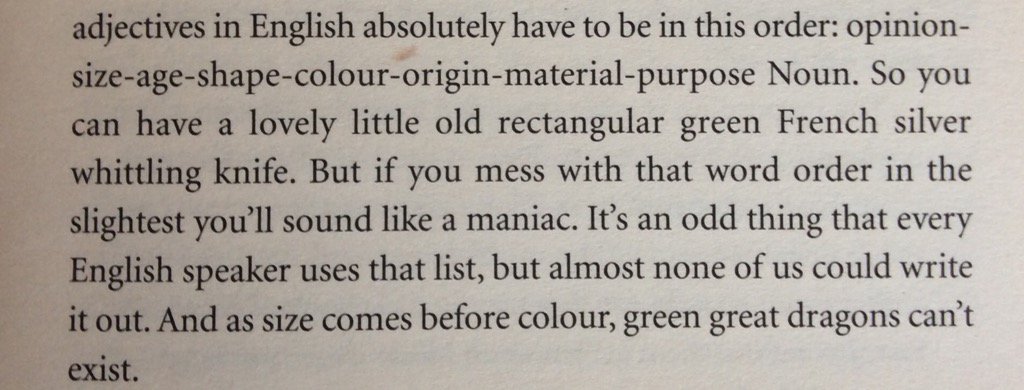
>adjectives in English absolutely have to be in this order: opinion-size-age-shape-colour-origin-material-purpose Noun. So you can have a loverly little old rectangular green French silver whittling knife. But if you mess with that word order in the slightest you'll sound like a maniac. It's an odd thing that every English speaker uses that list, but almost none of us could write it out. And as size comes before colour, green great dragons can't exist.
pseudopad t1_j6o2f0w wrote
Reply to ELI5: how is "productivity" measured? by Brickie78
For a bus driver, you could measure productivity by how often the departures are on time, how much fuel is spent for a certain route, etc.
Some of these are out of the driver's hands of course. They can't control how much traffic there is, but someone else in the company can change the routes to avoid traffic, service more people in the same amount of time by optimizing where the stops are based on how many and what demographic lives in the immediate area, etc.
This, in turn, makes the productivity of the bus drivers increase because they now get more work (measured here as passenger-miles per hour) done.
[deleted] t1_j6o21jv wrote
Reply to comment by RandomMe44 in ELI5: How did Elie Wiesel and fellow Jews not know about the concentration camps/Nazi exterminations? by LebSonny
[deleted]
drafterman t1_j6o1w8u wrote
Reply to ELI5: Who buys the stock I sell? by Raven019
It isn't the case that someone is always willing to buy at the same time someone wants to sell. What happens is if you want to sell your stock you can either find someone willing to buy it or you put out a sell order that basically is a notice saying "I'm willing to sell Y stocks for X amount of dollars." In which case you sit around and wait till someone is willing to fulfill that order.
On the flip side someone wanting to buy one can either grab one for those immediately willing to be sold or put in a buy order for a certain price.
So when you sell you're either fulfilling one of those buy orders or your putting in a sell order yourself and waiting for someone to buy it.
pseudopad t1_j6o1mk2 wrote
Reply to comment by Nameless408 in ELI5: how is "productivity" measured? by Brickie78
Or, same output but at lower production costs, for example by reducing the number of employees, or have them work more efficiently for a shorter period of time.
Ansuz07 t1_j6o1kv4 wrote
Reply to ELI5: Who buys the stock I sell? by Raven019
No, its another person just like you (or a fund, but I digress). It is rarely the company itself buying the stock (though buybacks do happen, but I digress again).
The number of buyers is always equal to the number of sellers - that is what the stock price actually is (the price at which buyers = sellers). The price is constantly adjusting to keep that statement true.
So, for example, if you want to sell stock at $100/share, maybe no one wants to buy it for that - they only want to buy at $80/share. Someone else, who really wants to sell will offer $90/share and someone else who really wants to buy will do that. The stock price is now $90. You still have your share at $100 and the guy wanting to pay $80 still doesn't have his, but since the number of people willing to sell at $90 = the number of people willing to buy at $90, that is where the price evens out.
[deleted] t1_j6o1ffo wrote
[removed]
jermleeds t1_j6o1ce1 wrote
Reply to eli5: What’s the difference between Tylenol, Advil and Aleve, and what are the strengths and weaknesses of each medication? by [deleted]
Basically for me, ibuprofen for injuries and joint or muscle aches, acetominophen for headaches, fevers & body aches.
blipsman t1_j6o4lt2 wrote
Reply to ELI5: Who buys the stock I sell? by Raven019
Other investors (not the company, in general) are buying the shares you are selling. If there isn't an even match of those who want to sell and those who want to buy, the price declines until the buyers and sellers are in equilibrium. If there are more wanting to buy than wanting to sell, then price increases.
Only when companies do share buybacks might your shares go to the company itself vs. another investor.