Recent comments in /f/philosophy
TacticAngel t1_iwrpqb0 wrote
Ultimately, if every action can be justified as moral, which I kind of reject as it just blows up ethics entirely, I'm not sure why they don't argue that throwing yourself off a bridge is, in fact, a net win for the environment. That not only ensures you do not reproduce, here stated as a net win, but you also stop polluting too, and probably feed some sort of aquatic life in the process.
Part of the answer is because not throwing yourself off a bridge is at least comparably moral. Alternatively, having children and teaching them to be good stewards of the earth imbues them with a much higher chance of actually cleaning the place up a bit as compared to said children not existing.
iiioiia t1_iwr36b0 wrote
Reply to comment by eliyah23rd in Utilitarianism is the only option — but you have to take conscious experience seriously first by Squark09
If you ever come into some $$$, let me know, and I will do likewise. :)
[deleted] t1_iwr2nfg wrote
[deleted]
eliyah23rd t1_iwr2f4v wrote
Reply to comment by iiioiia in Utilitarianism is the only option — but you have to take conscious experience seriously first by Squark09
Thank you so much.
iiioiia t1_iwqzoo9 wrote
Reply to comment by eliyah23rd in Utilitarianism is the only option — but you have to take conscious experience seriously first by Squark09
You are onto something.
Truenoiz t1_iwqzned wrote
Reply to comment by Squark09 in Utilitarianism is the only option — but you have to take conscious experience seriously first by Squark09
Deontology with non-malfeasance as a primary virtue is a stronger option- you don't even need to assume several precepts to make it so.
simonperry955 OP t1_iwqzevl wrote
Reply to comment by eliyah23rd in The structure of moral normativity by simonperry955
You're right, I take a descriptive approach. My personal view is that the world would be a better place (all concerned would thrive more) if everyone was prosocial and moral (i.e., enforced norms).
The descriptive case to be made depends on surely what you want to achieve. If it's mutual benefit, then prosociality is the way to go.
My understanding of the is-ought problem has moved on since I wrote the entry in the ebook. I provide a descriptive ought, not an imperative ought. I describe the fact that people feel they ought to X, and give natural reasons why they feel this way. To move to an imperative ought, one possible goal or imperative is the thriving or flourishing of the self and others, optimally. After all, each organism experiences a pressure or imperative to thrive or flourish.
Each entry in this list of features of morality, is a source of moral oughtness, including instrumental oughtness, which provides the original pressure to achieve goals. Moral oughtness is derived from the pressure to achieve goals jointly. So, moral oughtness comes from others towards me (partner control) as well as from me to others (responsibility).
eliyah23rd t1_iwqyyo8 wrote
Reply to comment by iiioiia in Utilitarianism is the only option — but you have to take conscious experience seriously first by Squark09
Rather than pour too many words on to the page, can I refer to the comment/caption in these posts:
https://www.instagram.com/p/Cj4_NgYsxUw/
https://www.instagram.com/p/CkIg-UkMbhw/
https://www.instagram.com/p/CkNx6RkMvQo/
I try to put a lot of the details directly in the description
iiioiia t1_iwqrori wrote
Reply to comment by eliyah23rd in Utilitarianism is the only option — but you have to take conscious experience seriously first by Squark09
What sort of an implementation do you have in mind?
ILikeNeurons t1_iwqo04l wrote
Reply to comment by rejectednocomments in Reproductive Autonomy and Climate Change by ADefiniteDescription
This is very true.
Like, go ahead and have kids if that's what you really want, but at least make a monthly call to Congress or something.
simonperry955 OP t1_iwqmncq wrote
Reply to comment by Skinonframe in The structure of moral normativity by simonperry955
But arguably, "rightness" (upholding moral principles) evolved in the context of obligate collaborative hunting and gathering. From there, it's free to be used in any context. The morality of helping a cat in a tree is more basic: empathic concern or compassion evolved in the context of child care, but became available for strangers too in humans.
Michael Tomasello, in "A Natural History of Morality", holds that a moral principle is a general standard of behaviour that applies to any collaboration [and, as I propose: pair bond, or family, or doctor's practice] alike.
One is free not to uphold moral principles or to do a good job, but if other people are relying on me, then I owe them to do so, because we are a "we", and I identify with "us".
eliyah23rd t1_iwqjtpn wrote
Reply to comment by iiioiia in Utilitarianism is the only option — but you have to take conscious experience seriously first by Squark09
Thank you so much.
Yes, we have spoken about it before.
I need collaborators for an implementation. Also more criticism of the core ideas.
That's why I hang out trying to talk to people.
iiioiia t1_iwqj07t wrote
Reply to comment by eliyah23rd in Utilitarianism is the only option — but you have to take conscious experience seriously first by Squark09
Ah, I think we've talked about this before right? As a fan of subversion: some of those are excellent.
Now we just need an implementation.
eliyah23rd t1_iwqic63 wrote
Reply to comment by iiioiia in Utilitarianism is the only option — but you have to take conscious experience seriously first by Squark09
Sure
https://www.instagram.com/eliyah23rd/
See the last two posts. I am struggling to upload a third but Instagram seems to be having some issue.
eliyah23rd t1_iwqi07r wrote
Reply to comment by simonperry955 in The structure of moral normativity by simonperry955
I think the best way to describe our difference is that your project is descriptive and mine is prescriptive. You want the to discover the cause and I am looking for solutions.
However, that simplifies our position a little. In order to propose solutions, I look to build the descriptive case correctly. I am very minimalist about descriptive assumptions, but I cannot avoid them all.
You, on the other hand, seem to propose a sort of “Inference to Best Explanation” argument for motivating the genealogy that you propose. This is a classic descriptive project strategy. However, your last comment highlights that there is a prescriptive wish behind your project, an agenda, if you will. While you present your evidence irrespective of moral outcome, you seem to be motivated by a belief that should your view be accepted, the world would be a better place.
One last point, if I may. You use the word “ought” a number of times. On page 20 you even use it with reference to Hume. However, like de Waal, your use of “ought” seems to be the hypothetical (IF you want X you ought to Y) meaning of “ought” and not the categorical (You ought to Y). To me it seems clear that Hume is very clear that he is referring to the categorical “ought”. I’d be interested to know whether you agree that (a) you are using the hypothetical and (b) Hume is using the categorical.
iiioiia t1_iwqegwu wrote
Reply to comment by eliyah23rd in Utilitarianism is the only option — but you have to take conscious experience seriously first by Squark09
> ethics as a game
This sounds interesting....but can you link to what you're referring to?
eliyah23rd t1_iwqe368 wrote
Reply to comment by iiioiia in Utilitarianism is the only option — but you have to take conscious experience seriously first by Squark09
Wow! Exactly!
I just did a few posts on the idea of ethics as a game on the Instagram link. Check out the comments where I expand on the aphorism.
[deleted] t1_iwqbjyk wrote
[removed]
iiioiia t1_iwqajxu wrote
Reply to comment by eliyah23rd in Utilitarianism is the only option — but you have to take conscious experience seriously first by Squark09
I think this is a plausible edge case - you could even be suicidal, yet get vaccinated to protect a loved one.
But I don't think this necessarily reaches a "should", as simple preference could be sufficient. In a sense, from certain perspectives, maybe "should' is purely a collective hallucination, like "rights", most of "truth", etc. Adult life is very much like a continuation of "playing house" from childhood.
[deleted] t1_iwq93j1 wrote
ILikeNeurons t1_iwq86vq wrote
I don't personally think it's helpful or appropriate to try to discourage people from having children they want. From a population perspective, it makes much more sense to focus on preventing unwanted pregnancies, because there are an awful lot of those, especially in the U.S., where our individual footprints are especially high.
Preventing unwanted pregnancies is a cost-effective and ethical way to reduce environmental destruction and minimize population growth, and 45% of pregnancies in the U.S. are unintended. Of those, 58% will result in birth. Comprehensive sex education would go a long way, too, and many states do not include it in their curricula, even though comprehensive sex education has strong bipartisan support among likely American voters. Many women at high risk of unintended pregnancy are unaware of long-acting reversible contraceptive options, and many men don't know how to use a condom properly, which does actually make a huge difference. Besides that, it could help to ensure everyone has access to effective contraception, so consider advocating policies that improve accessibility of long-acting reversible contraceptives and help get the word out that it is ethical to give young, single, childless women surgical sterilization if that is what they want.
As for the rest of the world, it would help to donate to girls' education, since educated girls tend to grow into women who choose smaller families.
All that said, population is not the most significant cause of climate change -- it's the market failure. That's why the single most impactful climate mitigation policy is a price on carbon, and the most impact you as an individual can have is to volunteer to create the political will to get it passed.

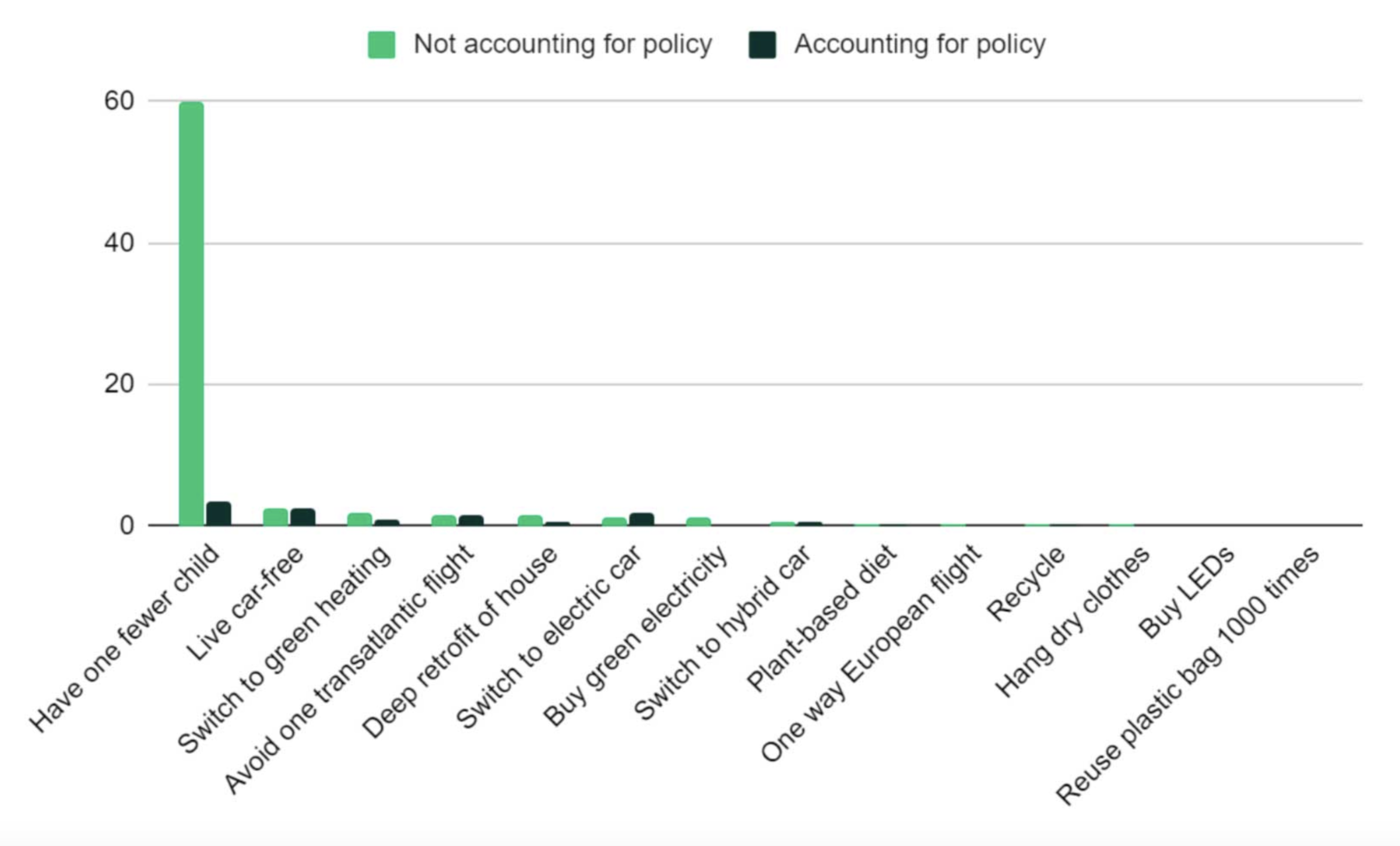
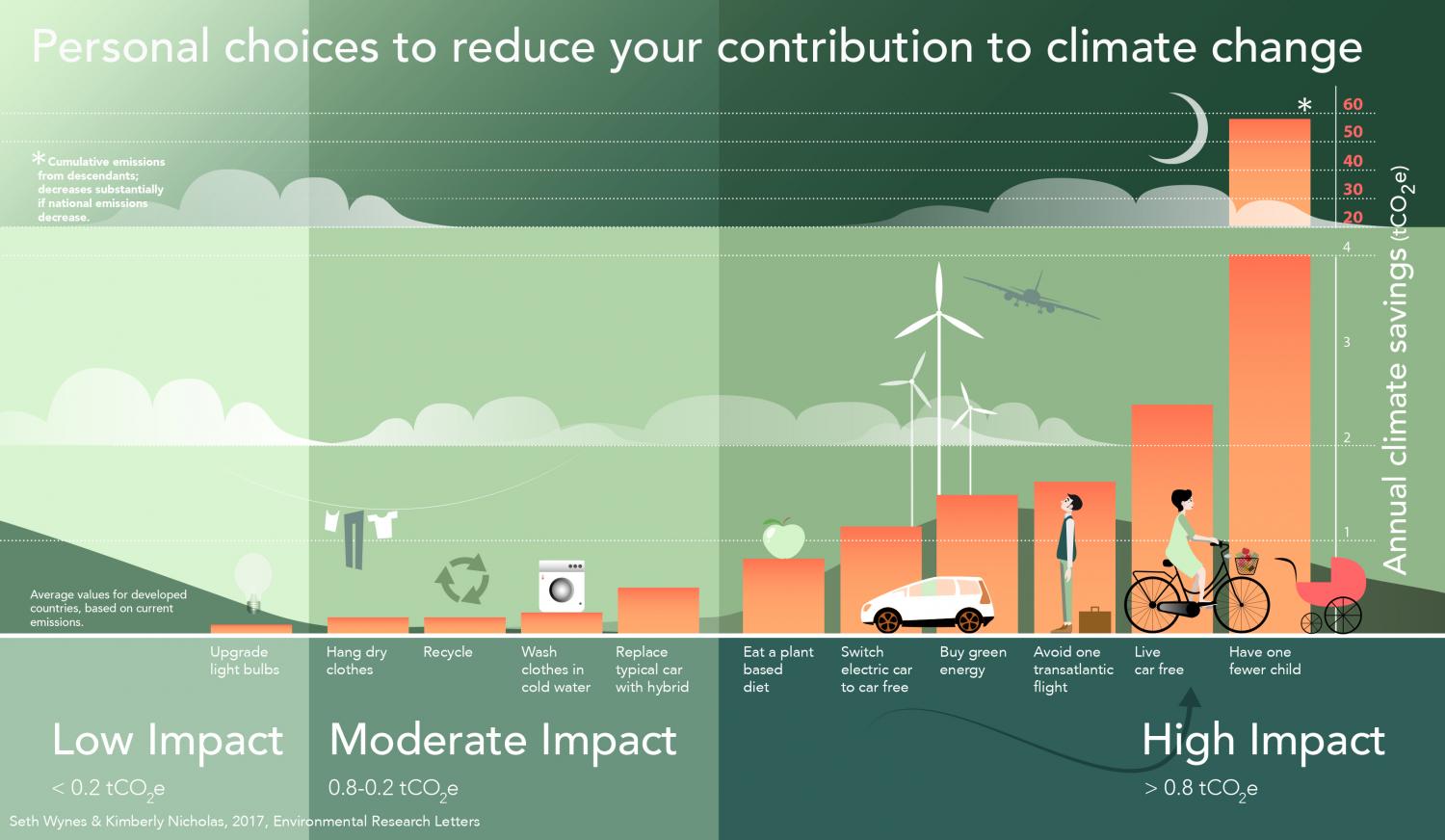
Policy changes absolutely dwarf the magnitude of the impact of having one less child.. Let's each do our part.
[deleted] t1_iwq7l2t wrote
Reply to comment by schizboi in Defending myth as truth - The Garden of Eden — The Unconscious Self and a Moral World by Melodic_Antelope6490
[deleted]
rejectednocomments t1_iwq7k49 wrote
I think this misses the main issue.
Whether and to what extent the decision of the average couple to have children makes the climate problem worse, depends on large-scale issues of policy and technology.
If we make the large-scale shift to solar, wind, and so on that we need, probably investments in carbon capture technology as well, it will be fine for people to continue having kids. If we don’t make those changes, well, whether you’re 1 meter under water or 50, you’re still drowning.
This is a problem that demands a large-scale, systematic solution. Talking about whether Joe and Jane should or shouldn’t have kids is a distraction.
[deleted] t1_iwq4cl2 wrote
Reply to comment by Melodic_Antelope6490 in Defending myth as truth - The Garden of Eden — The Unconscious Self and a Moral World by Melodic_Antelope6490
[deleted]
verdinatoc t1_iwrxvir wrote
Reply to /r/philosophy Open Discussion Thread | November 14, 2022 by BernardJOrtcutt
DISCLAIMER: I'm not a native speaker, so please excuse any language errors.
I'm currently 22 and I'd really appreciate your insights on my thoughts and some feedback.
Alright, straight to the point, going back to the basic questions:
• First of all these to me seem more like answered scientific questions. The reason I'm saying this, if for example ( in very simplistic terms and ideas for the sake of comprehension) scientists reach the end of the universe and see codes, bites etc and manage this way to prove that we live in eg a video game. Then, automatically the real meaning of our lives would be that we were created by some more advanced/powerful species that somehow preexisted to basically entertain them. Thus, someone could argue that if we were able to do anything at all at that point then we should probably try to break out of that artificial world we are trapped in and try to get to the real world where the aliens are. That means that we would've a straight answer to both a) and b).
• I believe in science. I just think it is the closest legitimate thing we humans have created to be able to understand the world.The reason why I trust it is because it seems to work, I see its applications in my daily life eg cars, aeroplanes,surgeries etc. I do lack knowledge though and I do somehow doubt the scientific method, in the sense of: what if it is outdated? What if it doesn't encompass all case studies? What if there is a better way? But I feel like, right now if you want to learn the truth, science is the closest you'll get to it.
• I don't believe in God. (Unless it's proven by science.) To me God, is the easy answer. “Why does it rain? Because God is Sad” etc. It just seems like an uneducated guess. I tend to believe that one of the many reasons humans preserved God for so long iss because it's a way to cope with their insignificance when looking at the enormity of the cosmos.
• We are born, we live, we die. It is this living that is bothering me. How am I supposed to live my life?
Thing is in my mind there are two worlds: A) The real world, meaning the earth, solar system universe and the scientific approach that all of this is slowly switching off, so everything we are doing is coming to an end, disappearing never to be seen again.
B) The human world, which is a subset of the real world which seems like a microworld where we are sucked into a total different reality with different rules and where people seem to live ignoring/forgetting what is really happening and only seem to regain consciousness during certain periods of their lives called "Life crises" only to be sucked again into the human reality.
I have no Philosophy background and my knowledge in general is very limited I don't know the ideas or the branches that exists and you might think I'm misusing the idea of Philosophy here trying to practically apply it to my life. But if, humans and the world will one day disappear then in my mind the following holds true:
That nothing is meaningful. That life should be seen as an experience. The same way you are landing on a new country for some days knowing you'll most likely never return and try to fit into your trip as much as good experiences as possible, to discover and experience stuff just for the sake of it just because you had the opportunity and why not have fun? So, it's like being the main character in an adventure. Like a nomad. I understand that this approach is sort of selfish. This makes me think it's important for me to travel meaning to explore that world, to see what it is like, to meet other people, to fall in love and to create. In my mind it's like a colourful celebration dancing around the fireplace. Having children, to add this is in, doesn't make much sense in my mind either. It's just like, I came, I experienced, I leave. Although this seems to be my reasoning if everything is going to die anyways, it is only in theory, because I live in the human world.
In the human world, I forget about the real world. In the human world I have to care about money, status about laws, social psychology, ethics etc and so many other things. I saw two cats fighting the other day as I was walking past them and I was like you are so stupid. Like, you are fighting right now in front of me doing everything you are supposed to do in the cat world when in reality from my point of view it's meaningless cause if I want to I can kill you both. It's just like, in retrospect everything we do in the human world when looking from above is mostly meaningless.
I don't know if I have puzzled you. It's just like, knowing what I know, I'm certain I don't know how to live my life. There isn't a handbook for life and I reject the ones given from various religions, although I'm definitely sure I'm affected even subconsciously by a lot of their teachings since the majority of the world is lead by them eg Christianity and I grew up in that society.
Like, being nice to your peers and helping the poor makes sense if you think that this is the law send by God and the earth is a testing period that will determine if you'll go to heaven or earth etc. But since, I don't believe in that I'm now called to reinvent my own values which I'll live my life by and it's very difficult, it is giving me headaches.
Any comments truly appreciated.