Recent comments in /f/science
fatesarchitect t1_j8glwba wrote
Reply to comment by Wersus_Invictus in Chinese researchers have reported what they claim is the world’s youngest person diagnosed with Alzheimer’s disease, which may overturn the conventional perception that cognitive impairment rarely occurs in young people. by Wagamaga
A friend of my tried for years and years to get pregnant. She got her miracle child, but within a few years her daughter was diagnosed with NP-C. It was awful to witness. She lost her only child in an absolutely brutal and gut wrenching fashion.
blackdragonstory t1_j8glhcl wrote
Reply to A study in the US has found, compared to unvaccinated people, protection from the risk of dying from COVID during the six-month omicron wave for folks who had two doses of an mRNA vaccine was 42% for 40- to 59-year-olds; 27% for 60- to 79-year-olds; and 46% for people 80 and older. by Wagamaga
A lot of these studies are based on low numbers of people,bad hypothesis or make vague conclusions.... Several years ago I had confidence in science and studies actually being based in facts and correct but ever since coronavirus I became very skeptical of it all. Too many people can lie or omit things just to create the outcomes they want and then said thing gets published by news or similar and people take it as facts.
[deleted] t1_j8gl5jd wrote
Reply to comment by -JPMorgan in Study on former citizens of East Germany sheds light on why people may choose deliberate ignorance by chrisdh79
[removed]
joxeloj t1_j8gktry wrote
Reply to comment by l4mbch0ps in Children as young as 4 years old show evidence of a network in the brain found in adults that tackles difficult cognitive problems, a new fMRI study found. Researchers were surprised, thinking it may take longer for the multiple demand network to differentiate in humans. by geoff199
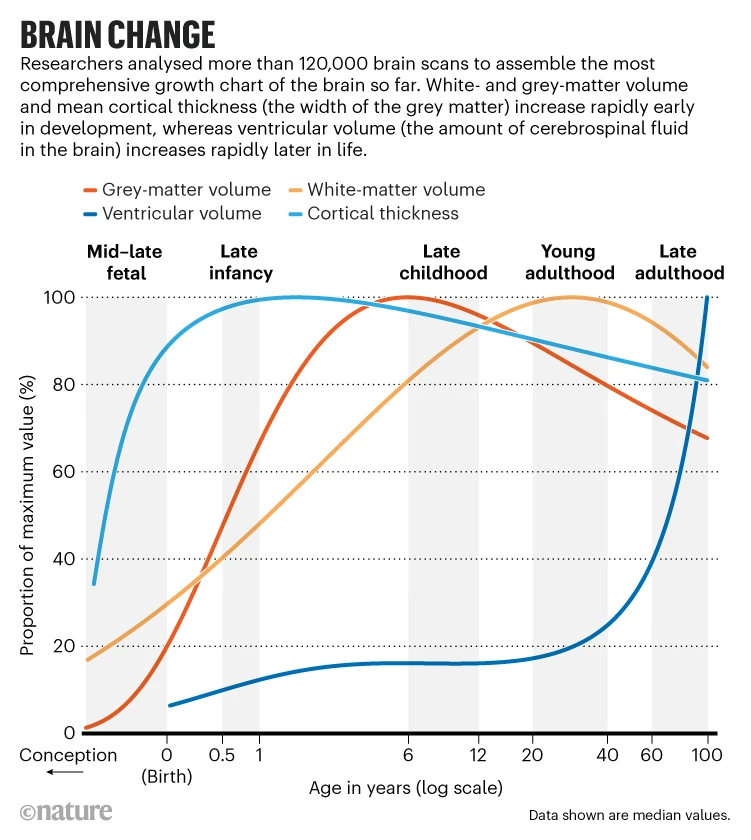
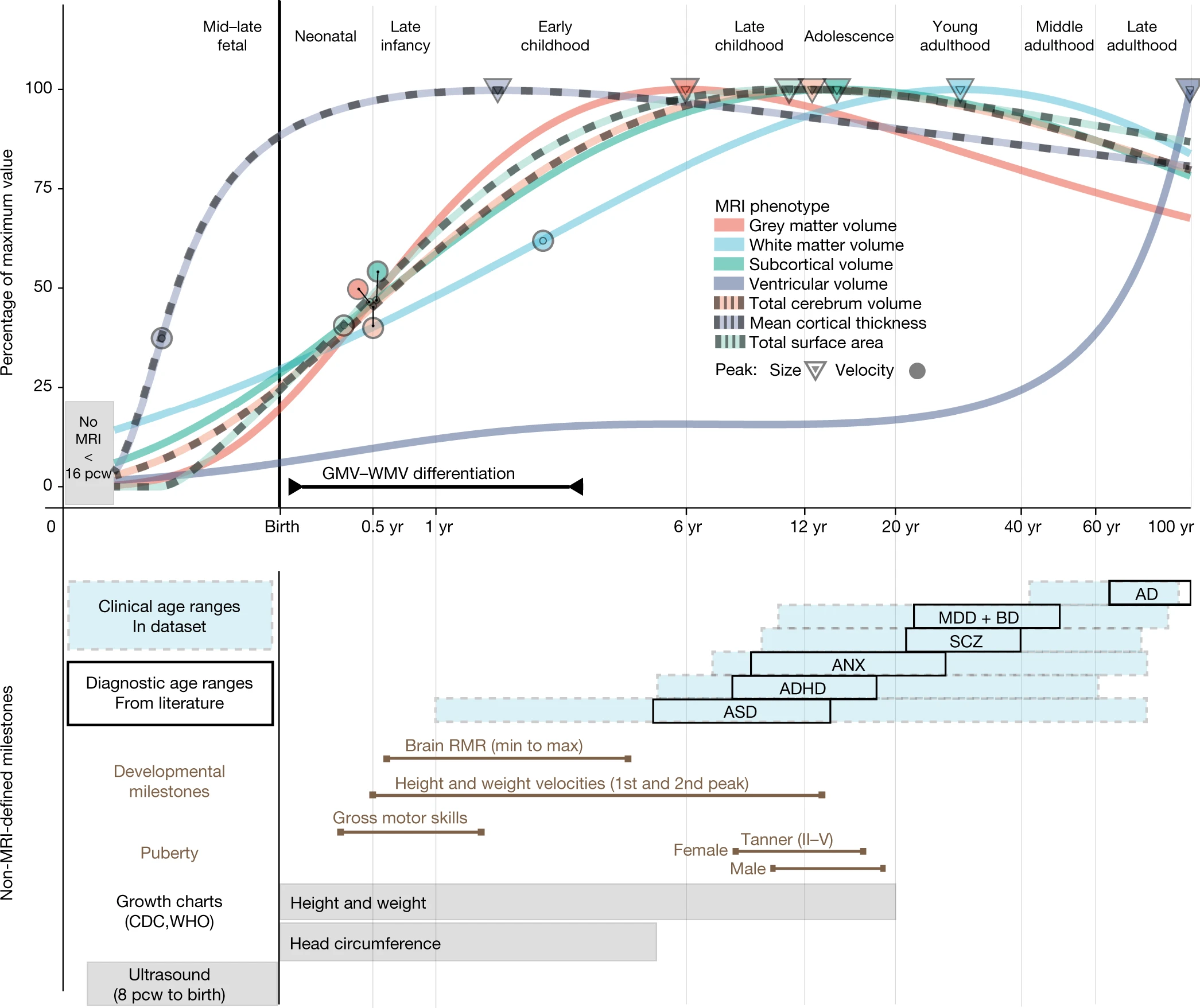
Kids are dumb but 25 is a pop sci meme based on extremely low levels of asymptotic but non-zero synaptic pruning and white development in the PFC not tied to any cognitive functions or behavioral changes. By 16 the vast majority of brain development is done and adult-level cognitive function is reached. By 18 you get adult-level psychosocial maturity. In the most extreme stretch of the data the latest I would say the brain is still meaningfully developing is 20 but I would personally draw the line at 18.
This is absolutely not the sole study I'm basing this on (it's consistent with decades of data), but if you want to read more here is a nice lay article about recent work characterizing brain development over the lifespan, and a nice summary figure. Here is the paper being summarized, which is somewhat approachable itself, with figure 3 being the most important summary figure. Note the general ideas are pretty consistent 20+ year old models of brain development

myasterism t1_j8gk1g8 wrote
Reply to comment by Scipion in A study found that CBD "exerted anti-cancer activity by reducing epithelial-mesenchymal transition and causing cell cycle arrest." by OregonTripleBeam
Hard disagree: the anxiolytic effects of CBD are not seen as consistently with THC. Also why we see the stereotype about weed and paranoia/anxiety.
epsilona01 t1_j8gjrzh wrote
Reply to comment by Evrimnn13 in The brain can rapidly detect and process fearful faces that are otherwise invisible to the eye. There appears to be a neural pathway for detection of fear, which operates automatically, outside of conscious awareness. by Wagamaga
Not particularly well, it's like a particularly sharp/sour body odour. Not the kind you get from extended sweating or not washing, but the moment you do smell it, you're fully alert. I assume there is purpose in that.
In Edinburgh, I'd put it down to the sheer number of people. As I looked back on the hole in the crowd where the railings had collapsed once I was away, you could see steam pouring from it as if it was on fire.
The moment I got off the train at Waterloo and it hit me and I knew for certain something was very wrong.
[deleted] t1_j8gjj1w wrote
[deleted] t1_j8gjc7q wrote
Reply to comment by chrisdh79 in Study on former citizens of East Germany sheds light on why people may choose deliberate ignorance by chrisdh79
[deleted]
-JPMorgan t1_j8gj445 wrote
Reply to comment by Foxs-In-A-Trenchcoat in Study on former citizens of East Germany sheds light on why people may choose deliberate ignorance by chrisdh79
They cling to the untrue belief that they care about truth although the evidence - the fact they'd rather avoid finding out about the past of their colleagues - contradicts it.
ctothel t1_j8gj2rq wrote
Reply to The brain can rapidly detect and process fearful faces that are otherwise invisible to the eye. There appears to be a neural pathway for detection of fear, which operates automatically, outside of conscious awareness. by Wagamaga
Noticing someone else’s fear in a split second saved me from getting punched in the face once. It was uncanny. I wonder if this is what happened.
Evrimnn13 t1_j8gi9w2 wrote
[deleted] t1_j8ghrf5 wrote
[deleted] t1_j8ghfqp wrote
Reply to comment by SpacedOutKarmanaut in A study in the US has found, compared to unvaccinated people, protection from the risk of dying from COVID during the six-month omicron wave for folks who had two doses of an mRNA vaccine was 42% for 40- to 59-year-olds; 27% for 60- to 79-year-olds; and 46% for people 80 and older. by Wagamaga
[removed]
International_Bet_91 t1_j8ghcg5 wrote
Reply to comment by gravitywind1012 in A study in the US has found, compared to unvaccinated people, protection from the risk of dying from COVID during the six-month omicron wave for folks who had two doses of an mRNA vaccine was 42% for 40- to 59-year-olds; 27% for 60- to 79-year-olds; and 46% for people 80 and older. by Wagamaga
Probably means the kind of people who get vaccinated also wear seatbelts, don't smoke, don't drink and drive, go for annual doctors visits etc etc etc.
And maybe even more relevant than the boring stuff, people who are homeless, addicted to drugs, running from the law, etc etc also don't get vaccinated.
meraero2 t1_j8gh908 wrote
Reply to comment by Mavyalex in Men with prostate cancer who also had relatives affected by the disease – or by other cancers with an inherited element like breast, ovarian or bowel cancer – were up to a fifth less likely to die from prostate cancer or any cause compared with those with no family history of cancer by giuliomagnifico
I have significant family history, so docs started testing me at 44 or 45. PSA started going up at 47 … accurately indicating a tumor, confirmed by biopsy which I had removed.
Doom_Corp t1_j8gh36s wrote
Reply to The brain can rapidly detect and process fearful faces that are otherwise invisible to the eye. There appears to be a neural pathway for detection of fear, which operates automatically, outside of conscious awareness. by Wagamaga
This article from the Atlantic I read a few weeks ago is pretty fascinating regarding psychopath development in children and how it translates into adulthood (and killers). Psychopathic brains generally cannot recognize fear facial expressions and their pleasure centers are stimulated with reward explicitly but punishments are essentially ignored. People with psychopathic brains have to train themselves into accepting a reward and response system that fits into normal empathetic conventions in order to move through society. https://www.theatlantic.com/magazine/archive/2017/06/when-your-child-is-a-psychopath/524502/
carpenter t1_j8gfpmv wrote
Reply to Social mobility refers to movement of individuals from one socio-economic strata to another. Social mobility is largely driven by personal motivation, education, skills and migration. But an analysis of historical data tells us that social mobility is primarily caused by changes in political rule. by rustoo
An analysis of a single point in time in a single country is not even remotely conclusive.
Feudamonia t1_j8geu9q wrote
Reply to comment by relbean in The brain can rapidly detect and process fearful faces that are otherwise invisible to the eye. There appears to be a neural pathway for detection of fear, which operates automatically, outside of conscious awareness. by Wagamaga
>the eye did not perceive the stimulus when in reality the eye did perceive the stimulus and the cerebral cortex did not perceive the stimulus
You're getting confused between sensation and perception. Sensation occurs when sensory receptors detect sensory stimuli. Perception involves the organization, interpretation, and conscious experience of those sensations.
unclekarl t1_j8gd4gm wrote
Reply to comment by YggdrasilsLeaf in Upon hearing recordings of wolf howls, older family dogs from more ancient breeds respond with longer howls — suggesting that genetic similarity with wolves affects dogs’ repertoire by marketrent
Source? I thought hyenas looked like dogs but were actually more closely related to cats.
Foxs-In-A-Trenchcoat t1_j8gclmw wrote
Reply to comment by TheManInTheShack in Study on former citizens of East Germany sheds light on why people may choose deliberate ignorance by chrisdh79
CD is clinging to an untrue belief in the face of solid evidence that they're wrong. It's not choosing to not know something.
TheManInTheShack t1_j8gcc8u wrote
Reply to comment by Foxs-In-A-Trenchcoat in Study on former citizens of East Germany sheds light on why people may choose deliberate ignorance by chrisdh79
Sure it is. They care about truth but also don’t want to know it.
From Wikipedia: In the field of psychology, cognitive dissonance is the perception of contradictory information, and the mental toll of it.
Foxs-In-A-Trenchcoat t1_j8gc2w3 wrote
Reply to comment by TheManInTheShack in Study on former citizens of East Germany sheds light on why people may choose deliberate ignorance by chrisdh79
That's not what cognitive dissonance is.
ledpup t1_j8glxnt wrote
Reply to comment by chrisdh79 in Study on former citizens of East Germany sheds light on why people may choose deliberate ignorance by chrisdh79
> Curiosity ... is one of the defining traits of human beings.
That's a curious claim.