Recent comments in /f/science
OfLittleToNoValue t1_j8m9n4o wrote
Reply to comment by NuggetMDr in Study finds link between ‘free sugar’ intake and cardiovascular disease by YoanB
I've seen many people resist reports like this to (wrongly) blame cholesterol and saturated fat.
BurnerAcc2020 t1_j8m9ike wrote
Reply to comment by PsychologicalLuck343 in New study shows Acceleration of global sea level rise imminent past 1.8℃ planetary warming by 9273629397759992
There's no need to think about it because it's not going to happen in the first place.
Studies show that even warming of over 4 degrees by the end of the century (which is higher than what is now expected) reduces ocean biomass by about 20%.
https://www.nature.com/articles/s41467-020-15708-9
>Significant biomass changes are projected in 40%–57% of the global ocean, with 68%–84% of these areas exhibiting declining trends under low and high emission scenarios, respectively.
>
>...Climate change scenarios had a large effect on projected biomass trends. Under a worst-case scenario (RCP8.5, Fig. 2b), 84% of statistically significant trends (p < 0.05) projected a decline in animal biomass over the 21st century, with a global median change of −22%. Rapid biomass declines were projected across most ocean areas (60°S to 60°N) but were particularly pronounced in the North Atlantic Ocean. Under a strong mitigation scenario (RCP2.6, Fig. 2c), 68% of significant trends exhibited declining biomass, with a global median change of −4.8%. Despite the overall prevalence of negative trends, some large biomass increases (>75%) were projected, particularly in the high Arctic Oceans.
>
>Our analysis suggests that statistically significant biomass changes between 2006 and 2100 will occur in 40% (RCP2.6) or 57% (RCPc8.5) of the global ocean, respectively (Fig. 2b, c). For the remaining cells, the signal of biomass change was not separable from the background variability.
https://www.nature.com/articles/s41558-021-01173-9
>Mean projected global marine animal biomass from the full MEM ensemble shows no clear difference between the CMIP5 and CMIP6 simulations until ~2030 (Fig. 3). After 2030, CMIP6-forced models show larger declines in animal biomass, with almost every year showing a more pronounced decrease under strong mitigation and most years from 2060 onwards showing a more pronounced decrease under high emissions (Fig. 3). Both scenarios have a significantly stronger decrease in 2090–2099 under CMIP6 than CMIP5 (two-sided Wilcoxon rank-sum test on annual values; n = 160 for CMIP6, 120 for CMIP5; W = 12,290 and P < 0.01 for strong mitigation, W = 11,221 and P = 0.016 for high emissions).
>
>For the comparable MEM ensemble (Extended Data Fig. 3), only the strong-mitigation scenario is significantly different (n = 120 for both CMIPs; W = 6,623 and P < 0.01). The multiple consecutive decades in which CMIP6 projections are more negative than CMIP5 (Fig. 3b and Extended Data Fig. 3b) suggest that these results are not due simply to decadal variability in the selected ESM ensemble members. Under high emissions, the mean marine animal biomass for the full MEM ensemble declines by ~19% for CMIP6 by 2099 relative to 1990–1999 (~2.5% more than CMIP5), and the mitigation scenario declines by ~7% (~2% more than CMIP5).
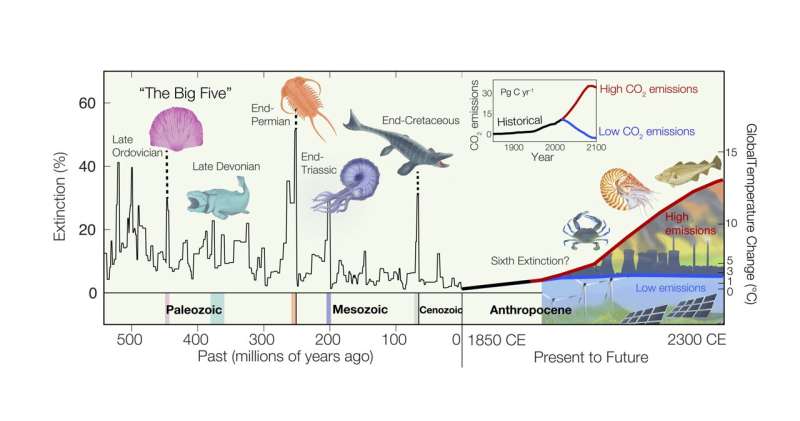
In fact, it was estimated a year ago that a mass extinction in the oceans would happen only if the emissions somehow continue to shoot straight up for 300 years. In fact, even that scenario, which would result in about ~12 degrees of warming, would "only" drive about 40% of the species in the ocean extinct. -
thesouthwillnotrise t1_j8m9fb5 wrote
Reply to Study: Cannabis Use Associated with Symptom Improvements in Patients with Headache Disorders by BoundariesAreFun
weed only helps with the nausea part. my migraines can’t be treated unless i have a BC powder near by and cold packs. what’s y’all’s advice?
[deleted] t1_j8m8vh7 wrote
AadamAtomic t1_j8m8pvz wrote
Reply to comment by beltalowda_oye in Study finds link between ‘free sugar’ intake and cardiovascular disease by YoanB
Diet knowledge Lite.
[deleted] t1_j8m82pp wrote
Reply to comment by [deleted] in Study finds link between ‘free sugar’ intake and cardiovascular disease by YoanB
[removed]
Fy_Faen t1_j8m6fmz wrote
Reply to comment by rather_be_redditing in High coffee consumption may triple kidney disease risk in some people by LordNPython
Or have a company not hire you, because you have a marker for an 'expensive' illness, and they want to keep their benefit costs down, so they only hire people with favourable genes.
SaxManSteve t1_j8m5pi4 wrote
Reply to comment by Darkhorseman81 in New study shows Acceleration of global sea level rise imminent past 1.8℃ planetary warming by 9273629397759992
Both can be true. It's true that western countries disproportionally use more energy and resources per capita than developing countries. It's also true that global human civilization is in an advanced state of ecological overshoot mainly because of overconsumption and overpopulation. We are currently consuming more resources than our ecosystems can regenerate naturally, we are operating beyond the earth's carrying capacity. On top of that we are dumping entropic waste back into the ecosphere in excess of nature’s assimilative capacities, which only speeds up the process of system wide ecological collapse that will absolutely lead to dramatic population contraction in the near future. In this sense, overshoot is actually the cause of climate change and numerous co-symptoms including plunging biodiversity, ocean acidification, tropical deforestation, landscape/soil degradation, contamination of food supplies, depleting aquifers, the pollution of basically every life-supporting system. Our contemporary growth obsessed technological civilization is literally consuming and polluting the biophysical basis of our own existence, and somehow we seem to think that there's nothing that can go wrong by adding a couple more billion humans on the planet.
MadScience_Gaming t1_j8m5fx5 wrote
Reply to Study: Cannabis Use Associated with Symptom Improvements in Patients with Headache Disorders by BoundariesAreFun
I used to suffer from really bad migraines connected with epilepsy. Weed not only prevents both, but if a migraine started, a quick bowl would get rid of it instantly. Migraines used to make me go blind, I remember the first time I tried smoking to alleviate the pain and seeing the visual fuzz shrink back down and vanish, literally in a few seconds.
[deleted] t1_j8m5cnv wrote
Reply to comment by [deleted] in Study finds link between ‘free sugar’ intake and cardiovascular disease by YoanB
[removed]
GarugasRevenge t1_j8m51uq wrote
Reply to comment by LoudNinjah in New study shows Acceleration of global sea level rise imminent past 1.8℃ planetary warming by 9273629397759992
California burns every summer.
MonitorPowerful5461 t1_j8m4kwc wrote
Reply to comment by Coenclucy in Study links Covid-19 vaccination hesitancy in Africa to the use of media platforms that spread misinformation. The spread of the Covid-19 pandemic in sub-Saharan Africa was accompanied by unprecedented and recurring waves of misinformation and disinformation. by Wagamaga
I didn’t know that one. Thankyou, that’s also likely to be a factor
AndyTheSane t1_j8m2doo wrote
Reply to comment by grundar in New study shows Acceleration of global sea level rise imminent past 1.8℃ planetary warming by 9273629397759992
I'm a bit dubious about this; paleogeographic studies point to large (as in around 20m) sea level rises from the kind of temperature rise we've already seen or can project in a few decades. Now, it could be a matter of timing - it might take 1000 years or so for the full ice-sheet response - but it's not exactly reassuring.
[deleted] t1_j8m1wtr wrote
ButterBallTheFatCat t1_j8m1org wrote
Reply to comment by dsbllr in Study: Cannabis Use Associated with Symptom Improvements in Patients with Headache Disorders by BoundariesAreFun
But if it says weed good you can't scream propaganda just cause it says weed good
adornoaboutthat t1_j8m0g58 wrote
Reply to comment by PsychologicalLuck343 in New study shows Acceleration of global sea level rise imminent past 1.8℃ planetary warming by 9273629397759992
If the ocean dies, so will humanity. The ecosystem aka the web of life is interconnected.
tarbuck t1_j8lzbz4 wrote
Reply to Study: Cannabis Use Associated with Symptom Improvements in Patients with Headache Disorders by BoundariesAreFun
"Headache Disorders" appears to only refer to migraines in this instance. Other disorders such as cluster headaches were not considered.
[deleted] t1_j8ly7o7 wrote
dsbllr t1_j8ly2nk wrote
Reply to comment by ButterBallTheFatCat in Study: Cannabis Use Associated with Symptom Improvements in Patients with Headache Disorders by BoundariesAreFun
I think the frustration is there's always a new article that refers to a study and vast majority of the time it's BS or the truth is over extended.
We need proper studies that are not influenced to make marijuana look bad or good.
[deleted] t1_j8ly19h wrote
Reply to comment by [deleted] in Study finds link between ‘free sugar’ intake and cardiovascular disease by YoanB
[removed]
Taifood1 t1_j8lxnu7 wrote
“While meta-analyses of observational studies have found that intake of sugar-sweetened beverages (SSBs) is associated with IHD [12,13,14,15], the associations between total dietary free sugars and risk of CVD and CVD subtypes remain unclear [2, 16, 17].”
This doesn’t sound very definitive to me.
[deleted] t1_j8lxf1e wrote
Reply to comment by TheTrueSleuth in Study finds link between ‘free sugar’ intake and cardiovascular disease by YoanB
[deleted]
Skullmaggot t1_j8lwnlq wrote
Reply to comment by [deleted] in Researchers found that joint play of two individuals, induced robust between-brain synchronization in parts of the brain, as if the two brains functioned together as a single system by giuliomagnifico
All this proves is that they share one brain cell.
[deleted] t1_j8lwltn wrote
Reply to comment by Neat_Youth470 in Study on former citizens of East Germany sheds light on why people may choose deliberate ignorance by chrisdh79
[removed]
Peter_deT t1_j8m9ohl wrote
Reply to comment by Dalmah in New study shows Acceleration of global sea level rise imminent past 1.8℃ planetary warming by 9273629397759992
Tide gauges give you a historical baseline. Satellite radar altimeters give you sea-level at any place to within a few millimetres. That's how they know about the dips and rises. They now have records over several decades.