Recent comments in /f/science
helm t1_j8mg4f4 wrote
Reply to comment by Propeller3 in For those interested in communal/common mycorrhizal networks (e.g., Finding the Mother Tree) - Positive citation bias and overinterpreted results lead to misinformation on common mycorrhizal networks in forests Nature Ecology & Evolution by Propeller3
Thanks! I wanted to check since it wasn't cataloged as a "research paper".
[deleted] t1_j8mfn7y wrote
[removed]
Propeller3 OP t1_j8mfkb8 wrote
Reply to comment by helm in For those interested in communal/common mycorrhizal networks (e.g., Finding the Mother Tree) - Positive citation bias and overinterpreted results lead to misinformation on common mycorrhizal networks in forests Nature Ecology & Evolution by Propeller3
I can, yes. This is one of the top journals in Ecology & Evolution and has a stringent peer review process. Specifically from this article:
>Peer review information Nature Ecology & Evolution thanks Peter Kennedy, Toby Kiers and the other, anonymous, reviewer(s) for their contribution to the peer review of this work.
SaxManSteve t1_j8mfa2n wrote
Reply to comment by BurnerAcc2020 in New study shows Acceleration of global sea level rise imminent past 1.8℃ planetary warming by 9273629397759992
IPCC population projection models are often criticized for having simple assumptions. They generally model predicted population based on the expected rate of world GDP growth and the correlated predicted reduction in birth rates. They don't use a system dynamics based model, that could model the complexities of overshoot and climate change and its impacts on population. For example global warming will have varying levels of cascading non-linear effects on extreme weather events, things like increases in economic inequality, increase in domestic and international conflict, increase in state fragility, increase in pandemics, increase in population displacement and migration, decrease in ecological biodiversity, decrease in food, fuel, and water resources, increase in droughts and desertification of fertile land, increased fragility of global supply chains, ect..... None of these factors are part of the IPCC models, meaning that their predictions shouldn't be taken as realistic predictions of populations. Rather they should be seen as models that predict population numbers in a world where climate change and overshoot will have little to no impact on human civilization in the near future.
It's also no secret within academic climate science circles that the IPCC has long been politically motivated to underestimate the scale of the problem. Which is why very few climate scientists actually believe that the Paris Accord is realistic. We all know there is no chance the world can avoid 1.5 C mean global warming and that we will likely see a potentially disastrous 2 C increase by 2050. Many already assume that there will be no remaining carbon budget even for the 2 C target
The IPCC infamously fails to account for carbon cycle feedbacks and their associated tipping points when setting their own emissions targets. Meaning that even a 2C warming may well trigger irreversible runaway “hothouse Earth” conditions. In coming years, we will see an ice-free Arctic Ocean, more rapidly melting permafrost, methane releases, an increase in wildfires, and other short-term positive feedbacks that will put climate change on steroids.
Even in the best case, the world can expect more and longer heat waves and droughts, more violent tropical storms, extended wild-fire seasons, accelerating desertification, water shortages, crippled agriculture, food shortages, rising sea levels, and broken supply lines. Coastal cities will be flooded and some may eventually be abandoned. Many other cities are likely to be cut off from food-lands, energy, and other essential resources with the breakdown of national highway and marine transportation networks; this alone would make urban life untenable. According to the recent Environmental Risk Outlook 2021 (2021), at least 414 cities with a total 1.4 billion plus inhabitants, are at high or extreme risk from a combination of pollution, dwindling water supplies, extreme heat stress, and other dimensions of climate change.
From this perspective, it's absurd to even entertain the idea that adding 2+ billion more people on the planet in the next 20 years would be a good idea. We should be currently engaging in an international effort to reduce our current consumption, reduce our energy demand, reduce our birth rates, reduce economic inequality, and ultimately start to move away from a growth for the sake of growth economic model towards an ecologically sustainable economic system.
It's simply immoral and reckless to keep chugging along with the business as usual economic model. Doing so is to condemn billions of people to a brutish, painful and short life.
helm t1_j8mf4pf wrote
Reply to For those interested in communal/common mycorrhizal networks (e.g., Finding the Mother Tree) - Positive citation bias and overinterpreted results lead to misinformation on common mycorrhizal networks in forests Nature Ecology & Evolution by Propeller3
u/propeller3 can you verify that this "perspective" piece is peer-reviewed?
bigedd t1_j8mezyb wrote
Reply to comment by giuliomagnifico in Researchers take on the myriad complex questions of beer foam dynamics, pointing to more precise brewing and nozzle manufacturing by giuliomagnifico
Very insightful!
giuliomagnifico OP t1_j8memqb wrote
Reply to comment by bigedd in Researchers take on the myriad complex questions of beer foam dynamics, pointing to more precise brewing and nozzle manufacturing by giuliomagnifico
The researchsays that in order to have a more “consistent” beer foam, you need to look at the brewing process.
bigedd t1_j8megqg wrote
Reply to comment by giuliomagnifico in Researchers take on the myriad complex questions of beer foam dynamics, pointing to more precise brewing and nozzle manufacturing by giuliomagnifico
So why does it say 'more precise brewing'?
updatedprior t1_j8mec60 wrote
Reply to comment by SentorialH1 in Researchers found that joint play of two individuals, induced robust between-brain synchronization in parts of the brain, as if the two brains functioned together as a single system by giuliomagnifico
I would imagine that in a group exercise class, not only would the same parts of the brain be activated, but even the same muscles would activate at the same time!
giuliomagnifico OP t1_j8me81h wrote
Reply to comment by bigedd in Researchers take on the myriad complex questions of beer foam dynamics, pointing to more precise brewing and nozzle manufacturing by giuliomagnifico
Correct, the research is on the beer pouring not brewing.
[deleted] t1_j8mdv9y wrote
bigedd t1_j8mduii wrote
Reply to Researchers take on the myriad complex questions of beer foam dynamics, pointing to more precise brewing and nozzle manufacturing by giuliomagnifico
more precise brewing and nozzle manufacturing? I can't see anything in the article relating to brewing it's all about the transfer of already brewed beer to the glass.
Am I missing something?
updatedprior t1_j8mdtpz wrote
Reply to comment by NuggetMDr in Study finds link between ‘free sugar’ intake and cardiovascular disease by YoanB
Knowing is half the battle
[deleted] t1_j8mdqg1 wrote
Reply to comment by [deleted] in Study finds link between ‘free sugar’ intake and cardiovascular disease by YoanB
[removed]
Darkhorseman81 t1_j8mdmm4 wrote
Reply to comment by Ballsaxolotl in New study shows Acceleration of global sea level rise imminent past 1.8℃ planetary warming by 9273629397759992
Humans breed in response to adversity. It's how we've succeeded as a species.
Have 7 children, even if one survives, genes passed on.
We overcome environment with sheer numbers.
Ballsaxolotl t1_j8mdh7l wrote
Reply to comment by Darkhorseman81 in New study shows Acceleration of global sea level rise imminent past 1.8℃ planetary warming by 9273629397759992
Why do places with virtually no environmental protections have such high birth rates? There will be plenty of people in the future. They'll just all die in their 40s
Talinoth t1_j8mcbdm wrote
Reply to comment by Conscious-Donut in The brain can rapidly detect and process fearful faces that are otherwise invisible to the eye. There appears to be a neural pathway for detection of fear, which operates automatically, outside of conscious awareness. by Wagamaga
... Of course not. A subconscious brain picks up visual signals that indicate another person is fearful, and reacts accordingly - all without conscious input.
There is no "communication", let alone telepathic communication. It's just people using their eyes and brains.
AutoModerator t1_j8mc982 wrote
Reply to Researchers take on the myriad complex questions of beer foam dynamics, pointing to more precise brewing and nozzle manufacturing by giuliomagnifico
Welcome to r/science! This is a heavily moderated subreddit in order to keep the discussion on science. However, we recognize that many people want to discuss how they feel the research relates to their own personal lives, so to give people a space to do that, personal anecdotes are allowed as responses to this comment. Any anecdotal comments elsewhere in the discussion will be removed and our normal comment rules apply to all other comments.
I am a bot, and this action was performed automatically. Please contact the moderators of this subreddit if you have any questions or concerns.
Dr_Kintobor t1_j8mc77q wrote
Reply to comment by 0comment in New study shows Acceleration of global sea level rise imminent past 1.8℃ planetary warming by 9273629397759992
Ok so i have a solution. We kill everyone once they turn 65/ stop being productive workers, and then we process them into protein bars. Like a Soylent Logan's Run. I never said it was a nice solution, but it would solve aging demographics and world hunger at the same time.
BurnerAcc2020 t1_j8mbcxg wrote
Reply to comment by kytopressler in New study shows Acceleration of global sea level rise imminent past 1.8℃ planetary warming by 9273629397759992
No, I have to say that you misread the paper here.
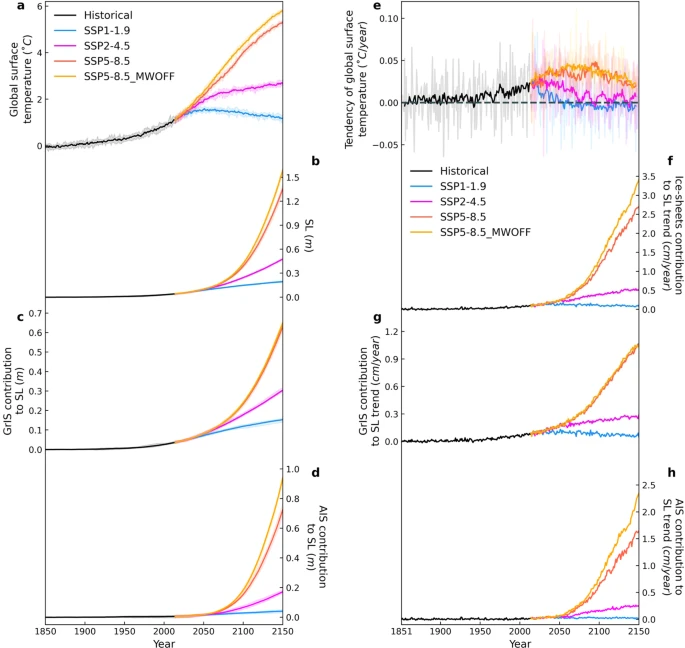
The first sentence you quoted discusses estimates for the 21st century (i.e. up until 2100), and it explicitly refers to AIS (Antarctic ice sheet) contribution. The actual paper's estimate in the second sentence is by 2150, not 2100, and it refers to ice-sheet contributions - i.e. Antarctic ice sheet and Greenland.
You need to look at Figure 3 of that paper. You'll see that in d), their estimate for AIS alone under SSP5-8.5 (the orange line - the higher yellow line is a more primitive simulation of the same scenario they run for comparison) is about 0.2 m by 2100 and 0.7 m for 2150.
Strict_Geologist_603 t1_j8magrb wrote
Reply to comment by Taifood1 in Study finds link between ‘free sugar’ intake and cardiovascular disease by YoanB
That's the introduction, talking about previous studies. They did the study to get more evidence and estabilish a more definitive link
[deleted] t1_j8mafxz wrote
Reply to comment by Darkhorseman81 in New study shows Acceleration of global sea level rise imminent past 1.8℃ planetary warming by 9273629397759992
[removed]
BurnerAcc2020 t1_j8maaiv wrote
Reply to comment by SaxManSteve in New study shows Acceleration of global sea level rise imminent past 1.8℃ planetary warming by 9273629397759992
> which only speeds up the process of system wide ecological collapse that will absolutely lead to dramatic population contraction in the near future.
Not according to even the scientists who otherwise agree that the future would be "ghastly", though?
https://www.frontiersin.org/articles/10.3389/fcosc.2020.615419/full > It is therefore also inevitable that aggregate consumption will increase at least into the near future, especially as affluence and population continue to grow in tandem (Wiedmann et al., 2020). Even if major catastrophes occur during this interval, they would unlikely affect the population trajectory until well into the 22nd Century (Bradshaw and Brook, 2014). Although population-connected climate change (Wynes and Nicholas, 2017) will worsen human mortality (Mora et al., 2017; Parks et al., 2020), morbidity (Patz et al., 2005; Díaz et al., 2006; Peng et al., 2011), development (Barreca and Schaller, 2020), cognition (Jacobson et al., 2019), agricultural yields (Verdin et al., 2005; Schmidhuber and Tubiello, 2007; Brown and Funk, 2008; Gaupp et al., 2020), and conflicts (Boas, 2015), there is no way—ethically or otherwise (barring extreme and unprecedented increases in human mortality)—to avoid rising human numbers and the accompanying overconsumption. That said, instituting human-rights policies to lower fertility and reining in consumption patterns could diminish the impacts of these phenomena (Rees, 2020).
Not to mention the more mainstream views like those of the IPCC (look at their population graphs).

helm t1_j8mgwso wrote
Reply to comment by [deleted] in Study finds link between ‘free sugar’ intake and cardiovascular disease by YoanB
> all sugars naturally present in fruit and vegetable juices
It's considered free sugar from the first sentence. It is confusing since orange juice is a juice and also "processed fruit". But in a juice, the sugars are separated from the fibers.