Recent comments in /f/singularity
chaddwoo t1_j6a84ji wrote
Reply to Google not releasing MusicLM by Sieventer
Google is choosing to die
No_Ninja3309_NoNoYes t1_j6a7t2u wrote
AI will be bigger in 2033, but I am afraid that it will run out of steam. The neural networks that are built today are like ladders to the moon. We need rockets and some sort of fuel. But I bet that if someone figures it out, it will seem pretty obvious in hindsight.
The rest is politics and tradition. Almost no one can compete with Silicon Valley. Some governments try, but it is not a priority for them.
just-a-dreamer- t1_j6a7m2t wrote
Nobody can live forever, for even stars die. Yet we can extend our lifes and have done so in the past
With AI, life extension will be big.
Practical-Mix-4332 t1_j6a7l0b wrote
Reply to comment by sgjo1 in Why did 2003 to 2013 feel like more progress than 2013 to 2023? by questionasker577
Also biotech and DNA sequencing tech has been improving exponentially. The cost of full genome sequencing is down to $100 from $10,000 in early 2010s and millions in early 2000s.
Phoenix5869 t1_j6a6nfu wrote
Most people dont like to admit it, but technology is slowing down significantly. Cures for aging or even treatments for it, nanobots, curing blindness / paralysis / alzheimers etc, lab grown / artifical organs etc or even regrowing teeth or a cure for the common cold are still decades away despite years upon years of ‘breakthroughs’.
im sure if you asked someone in 2013 what they think we would have in 2023, they would give an answer that seems ridiculous to us today. But no, 2023 is the same as 2003 except for smartphones, tablets, etc, better computers, and a few primitive gene therapies. What does that say about what 2043 or even 2053 will be like?
and if you dont believe me, go ask basically any expert in the relevant field(s) how far away even the simplest of these technologies are. You probably wont like what they tell you
Honest_Performer2301 t1_j6a68os wrote
Reply to Don't despair; there is decent likelihood that an extremely large amount of resources will flow from AGI to the common man (even without UBI) by TheKing01
Ubi will come from big tech companies. Not from workers taxs
CypherLH t1_j6a64u6 wrote
Reply to comment by Talkat in Google not releasing MusicLM by Sieventer
​
I've actually been surprised at how rapidly, and deeply, the anti-AI sentiment took hold in the art community. I still hope its mostly a vocal minority.
And yeah, as the models keep improving the anti-AI types will probably just get more shrill. It will be funny to see them keep trying to make fun of AI art as they keep having to get more and more picky about the flaws they point out in AI-generated content. At some point the models will figure out things like hands, and keep getting more and more consistently coherent.
Toasterstyle70 t1_j6a5zub wrote
I like you’re alliteration and colorful insults. Beautiful .
tatleoat t1_j6a5o2p wrote
I bet 2024 everyone will have their own private AI and if I want to accomplish anything that requires me to get in contact with someone I instead tell my AI what I need, then my AI gets in touch with their AI and they figure as much out as they can without involving us. Then they report back with further questions or "you now have an appointment scheduled for around five pm"
CypherLH t1_j6a5m5t wrote
Reply to comment by ImpossibleSnacks in MusicLM: Generating Music From Text (Google Research) by nick7566
It is beginning to feel like we're entering into the end game, at least the opening phase of it. We're finally starting to see the stuff futurists have been talking about since at least the early 90's in terms of a lead-up to a singularity.
CypherLH t1_j6a5b3i wrote
Reply to comment by wavefxn22 in Google not releasing MusicLM by Sieventer
I get see how that might be frustrating but "style" cannot, and should not, be something that can be copyrighted. The negatives of doing this would outweigh the positives.
CypherLH t1_j6a4za4 wrote
Reply to comment by BigZaddyZ3 in Google not releasing MusicLM by Sieventer
I can see your point but I optimistically assume that a larger amount of art in total will also mean a larger amount of quality art.(even if its a small percentage of the total) And the same AI tools that generate art will also be able to help people seek out art that appeals to them. The best art will still rise to the top and there will still be a skill in things like worldbuilding, setting style guides, etc.
ElvinRath t1_j6a48uz wrote
Reply to Has anybody read the webcomic Seed? by Diacred
Yep! I did.
I recommend it too. I talked about it a few days ago in the sub discord :D
tobbtobbo t1_j6a3r7u wrote
Reply to comment by [deleted] in Google not releasing MusicLM by Sieventer
Maybe they’re simply holding back and we come out with a truly innovative finished product. Other smaller companies have more to prove quickly
Class-Concious7785 t1_j6a3dfw wrote
Reply to comment by [deleted] in Last night I had perhaps the most interesting conversation of my life entirely with a Joseph Stalin chat AI. We discussed hours of philosophy and morals, and it's responses and original questions truly baffled me. Part 1 of the chat log is listed below. by TBabb01
Germany, Italy, and Japan are English now?
Class-Concious7785 t1_j6a3b3z wrote
Reply to comment by [deleted] in Last night I had perhaps the most interesting conversation of my life entirely with a Joseph Stalin chat AI. We discussed hours of philosophy and morals, and it's responses and original questions truly baffled me. Part 1 of the chat log is listed below. by TBabb01
Once again, you flat out lied
Kaje26 t1_j6a2ymz wrote
[deleted] t1_j6a1ajw wrote
Reply to comment by Class-Concious7785 in Last night I had perhaps the most interesting conversation of my life entirely with a Joseph Stalin chat AI. We discussed hours of philosophy and morals, and it's responses and original questions truly baffled me. Part 1 of the chat log is listed below. by TBabb01
[deleted]
TopicRepulsive7936 t1_j6a14pn wrote
People will give you all kinds of strange answers but the truth is that it's the difference between subjective and objective change and your chosen perspective on it all.
[deleted] t1_j6a117u wrote
Reply to comment by Class-Concious7785 in Last night I had perhaps the most interesting conversation of my life entirely with a Joseph Stalin chat AI. We discussed hours of philosophy and morals, and it's responses and original questions truly baffled me. Part 1 of the chat log is listed below. by TBabb01
[deleted]
Hotchillipeppa t1_j69yw79 wrote
Reply to comment by questionasker577 in Why did 2003 to 2013 feel like more progress than 2013 to 2023? by questionasker577
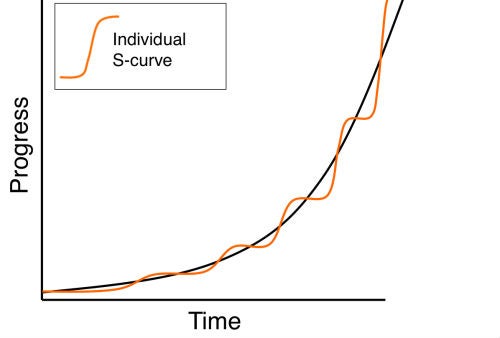
It might still technically be an "s curve" but the curve up with ai will be so high that the s shouldnt come down for a long while.
GayHitIer t1_j69yran wrote
Reply to comment by questionasker577 in Why did 2003 to 2013 feel like more progress than 2013 to 2023? by questionasker577
Combination of the two. But still s curves.
sgjo1 t1_j69ymno wrote
I think much of the progress was under the radar and out of public view. OpenAI was founded in 2015 and just reached mainstream consciousness with their product launches. Also in 2015, I met people working on LLM and NLP at Google, and it appears Google was reluctant to release some of this tech but now they want to since they want to compete with OpenAI.
genshiryoku t1_j6a85jx wrote
Reply to Why did 2003 to 2013 feel like more progress than 2013 to 2023? by questionasker577
Because Moore's Law largely stopped around ~2005 when Dennard Scaling stopped being a thing. Meaning clockspeeds have hovered around the 4-5Ghz rate for the last 20 years time.
We have started coping by engaging in parallelism through multi-core systems but due to Amdahls Law there is a diminishing return associated with adding more cores to your system.
On the "Instructions Per Cycle" front we're only making slow linear progression similar to other non-IT industries so there's not a lot of gain to be had from this either.
The reason why 2003-2013 feels like a bigger step is because it was a bigger step than 2013-2023. At least from a hardware perspective.
The big innovation we've made however is using largely parallelized GPU cores to accelerate machine learning on the extremely large data sets large social media sites have which has resulted in the current AI boom.
But yeah you are correct in your assessment that computer technology have largely stagnated since about ~2005.