Recent comments in /f/space
LilyoftheRally t1_j669mod wrote
Reply to comment by Fwahstah in In Memory of "Seven" - A poem for the seven astronauts who perished on January 28, 1986 by graboidian
I was in 7th grade when we lost Columbia.
Oh_ffs_seriously t1_j668baq wrote
Hope they're going to fsre better than Planetary Resources or Deep Space Industries.
jrp55262 t1_j666ppr wrote
Reply to NASA's Annual Day of Remembrance today, Jan. 26, honors the astronauts who died during the Apollo 1 fire and the Challenger and Columbia space shuttle disasters. by clayt6
Has anyone noted that all of NASA's fatal accidents launched in January? Maybe they should take the month off...
DarthIndifferent t1_j666b94 wrote
Reply to If you could instantaneously place a space telescope at any desired distance (LYs), from any planet/galaxy etc., where would it be and what would you be documenting? And for what purpose? by kennyarsen
66 million LY away, looking at Earth so we can watch the dinosaurs get whacked.
[deleted] t1_j664fc8 wrote
[removed]
[deleted] t1_j661xnn wrote
Reply to comment by jemull in In Memory of "Seven" - A poem for the seven astronauts who perished on January 28, 1986 by graboidian
[removed]
AurumArgenteus t1_j661up1 wrote
Reply to If you could instantaneously place a space telescope at any desired distance (LYs), from any planet/galaxy etc., where would it be and what would you be documenting? And for what purpose? by kennyarsen
Assuming it can communicate back even for an a few moments, the inside of a black hole. Assuming it cannot, probably inside a nebula at that age where rocky planets can begin forming. And assuming the comms are bound by physics, choose one of the interesting moons NASA and others aren't going to.
Intelligent_idiot-_- t1_j661mq4 wrote
Reply to comment by Feeling_Percentage_9 in If you could instantaneously place a space telescope at any desired distance (LYs), from any planet/galaxy etc., where would it be and what would you be documenting? And for what purpose? by kennyarsen
Unless it has some seriously efficient thrusters, it probably wouldn’t last long because of all the orbiting stars
[deleted] t1_j65ze5b wrote
majorbraindamage t1_j65xr0b wrote
Reply to If you could instantaneously place a space telescope at any desired distance (LYs), from any planet/galaxy etc., where would it be and what would you be documenting? And for what purpose? by kennyarsen
Ist choice: 0LY, in my back yard so I could cruise the skies at my leisure 2nd choice: I dont know where to put it, but I'd love to have a dedicated scope to look for habitable planets.
Feeling_Percentage_9 t1_j65wr1m wrote
Reply to comment by Intelligent_idiot-_- in If you could instantaneously place a space telescope at any desired distance (LYs), from any planet/galaxy etc., where would it be and what would you be documenting? And for what purpose? by kennyarsen
Similar, but I would place it at one of the Lagrange points of our black hole.
kennyarsen OP t1_j65wju9 wrote
Reply to comment by _PM_ME_YOUR_FORESKIN in If you could instantaneously place a space telescope at any desired distance (LYs), from any planet/galaxy etc., where would it be and what would you be documenting? And for what purpose? by kennyarsen
Yes, I forgot to include that.
MugillacuttyHOF37 t1_j65wd1v wrote
Reply to comment by sardoodledom_autism in Netflix Special Challenger The Final Flight - curious omission. by GhostRiders
Punished for doing the right thing…sounds about right smh
_PM_ME_YOUR_FORESKIN t1_j65vht6 wrote
Reply to If you could instantaneously place a space telescope at any desired distance (LYs), from any planet/galaxy etc., where would it be and what would you be documenting? And for what purpose? by kennyarsen
Are we assuming like — instant reception of data? Or like, we’d have to wait potentially billions of years to receive the first images?
rogerdanafox t1_j65tccm wrote
Reply to If you could instantaneously place a space telescope at any desired distance (LYs), from any planet/galaxy etc., where would it be and what would you be documenting? And for what purpose? by kennyarsen
Robert bussard Proposed placing a telescope 55 au from sun To use the sun as a Gravitational lense to view distant objects
[deleted] t1_j65sukp wrote
Reply to comment by monkee67 in It’s Not Sci-Fi—NASA Is Funding These Mind-Blowing Projects by monkee67
[removed]
dentalstudent t1_j65rkx7 wrote
Reply to comment by danielravennest in Asteroid-Mining Startup Plans First Private Mission to Deep Space by psychothumbs
I agree there's no point in sending humans, that was just the plot. I think what it got right was the idea that it's best to use the mining products in space since there is no point to shipping them planetside
WictImov t1_j65rdv4 wrote
Reply to comment by cousgoose in If you could instantaneously place a space telescope at any desired distance (LYs), from any planet/galaxy etc., where would it be and what would you be documenting? And for what purpose? by kennyarsen
I don't think using a black hole as a gravitational lens would achieve your objective. A simple lens like a magnifying glass does not work like a set of lenses with well-placed relative distances like a telescope (or microscope). Try using a magnifying glass to see something in the distance. It doesn't work, it will only focus on something closer to it than it is to your eye.
This is all moot however because you would see those things with more clarity if you placed the space telescope close to them, to begin with.
AsherKendrell t1_j65rcag wrote
Reply to Why are "metals" more effective at cooling molecular clouds than hydrogen and helium? by Thomas_Bonk
The primary way molecular clouds cool is by emitting the energy of the heat as light, which can escape the cloud.
A hot cloud of gas means there's lots of atoms and electrons zipping around, bumping into each other. If one of those bumps gives enough energy to an atom's electron, that electron gets excited to a higher energy level. When that excited electron jumps back down to a lower one, it emits the energy difference as light. Hydrogen and Helium are very simple atoms, meaning they only have 1-2 electrons to excite, few energy levels to excite to, and the minimum energy you need to make that first jump is higher. Conversely, "metals" have many more electrons and much more complex energy level structures with smaller, easier to accomplish jumps. Molecules, such as H2O, CO2, etc even more so. Therefore metals and molecules are much more likely to be able to take the energy of thermal collisions and convert it into outgoing light.
Take a look at these spectra for a visual: https://images.nagwa.com/figures/628134219594/1.svg
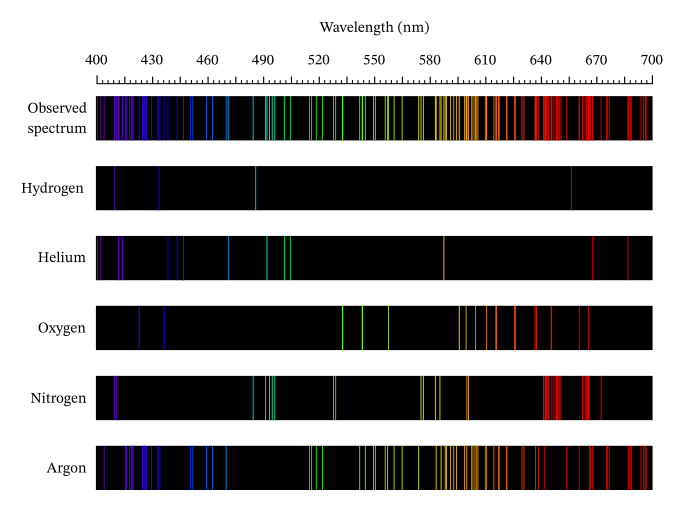
Each vertical line corresponds to one possible electron transition in the corresponding atom. You can imagine collisions as randomly firing along these spectra, and only when they hit one of the lines does light get emitted. So you can see, for H and He you're going have a way harder time getting hits. (And, in real life your shots aren't uniformly spread either, but skewed towards the red side at the temperatures molecular clouds are typically at. For hydrogen, you'd only have a single target to try to hit, vs the forest of lines that nitrogen has for example)
FragleFameux t1_j65r5rp wrote
Reply to comment by danielravennest in Rosette Nebula by Kujisann
Alright ! Thanks for the clarification.
beef-o-lipso t1_j65r53i wrote
Reply to comment by Odd_Republic5346 in How far out does the suns light travel into space? by Seraph_Unleashed
4.5 bn years then. The principle stands.
Not accounting for the universe expansion, someone X light years away would see another spot in the universe as it was X years ago cause that's own long it took light to travel from there to where ever the observer is.
SaishDawg t1_j65r3ph wrote
Reply to If you could instantaneously place a space telescope at any desired distance (LYs), from any planet/galaxy etc., where would it be and what would you be documenting? And for what purpose? by kennyarsen
I would say our best candidate for a planet with intelligent life. That’s cheating though since we don’t have one (maybe life, but no signs of intelligence yet). The center of the galaxy (outside its black hole) would also be fascinating to pan around what must be a dizzyingly different night sky.
You do have the separate problems of getting any information back home (in a reasonable time at the speed of light) and potentially power (could we ever get a signal from current technology telescopes we place really far away)?
ChrisARippel t1_j669ogv wrote
Reply to comment by Varsect in If you could instantaneously place a space telescope at any desired distance (LYs), from any planet/galaxy etc., where would it be and what would you be documenting? And for what purpose? by kennyarsen
Observations from the space telescope would be looking to disprove isotropy from that location. If the space telescope doesn't disprove isotropy from that location, this is at least partial confirmation. Similar to Eddington's 1919 eclipse test of Einstein's Theory of Relativity.
Milky Way may well be invisible to the space telescope, but other galaxies may well be visible from both directions.