Recent comments in /f/space
[deleted] t1_j78efme wrote
Reply to We should weaponize the ISS by dragonridge101
[removed]
[deleted] t1_j78e2zt wrote
Reply to We should weaponize the ISS by dragonridge101
[removed]
[deleted] t1_j78dn0b wrote
Reply to We should weaponize the ISS by dragonridge101
[removed]
[deleted] t1_j78djnj wrote
Reply to We should weaponize the ISS by dragonridge101
[removed]
PandaEven3982 t1_j78d238 wrote
Reply to comment by ShyElf in How does water work in a closed container in space? by UnhappyLibrary2540
This one.
Just BTW, in theory, we could use the steam transition in forming O'Neill colonies. They're still impractical today, but I have hopes. :-)
[deleted] t1_j78css5 wrote
Reply to We should weaponize the ISS by dragonridge101
[deleted]
[deleted] t1_j78ckb1 wrote
Reply to We should weaponize the ISS by dragonridge101
[removed]
[deleted] t1_j78ccze wrote
Reply to We should weaponize the ISS by dragonridge101
[removed]
[deleted] t1_j78c72l wrote
Reply to We should weaponize the ISS by dragonridge101
[removed]
ClapAlongChorus t1_j78bztg wrote
Reply to comment by blackbarminnosu in Apollo 11 astronaut Michael Collins laid to rest at Arlington National Cemetery by Ok_Copy5217
but he's still the most famous michael collins outside the UK: https://en.m.wikipedia.org/wiki/Michael_Collins
[deleted] t1_j78bwlg wrote
Reply to comment by -Lysergian in New satellite to police carbon dioxide emitters from space by AbbydonX
[removed]
SaulsAll t1_j78b80m wrote
Your thought is in the right direction: raising temp without increasing volume is going to raise pressure. And a higher pressure is going to mean it take more heat for water to change phase from liquid to gas. The phase diagram for water is what is important here. I think though this might be a better question for r/askscience, especially when hypothesizing an unbreakable container or an unlimited amount of heat.
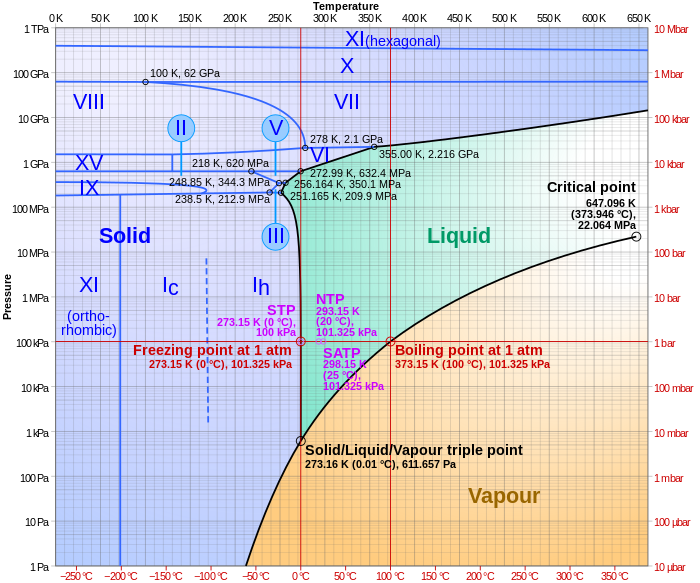
Edit: Looking at other charts, there seems to be a region called supercritical fluid

ShyElf t1_j78azmb wrote
No, you'd just get hot and high pressure water until it went supercritical and there was no longer a sharp gas/water phase transition. Also, the pressure would be rapidly huge, because you're not letting the water undergo thermal expansion. Also, it would do the same thing on Earth.
triffid_hunter t1_j78asm8 wrote
Steam engine boilers have been doing something similar for over a hundred years - boiling occurs when the partial pressure of a liquid exceeds ambient atmospheric pressure, so you can just jack up the pressure to force a hot liquid to not boil, and they kinda do this by themselves by simple thermal expansion in a filled closed volume.
From memory, steam engine boilers commonly operated at something like 300+°C to get sufficient working pressure for efficient operation, and there were numerous boiler explosion disasters before we worked out how to make them strong enough to withstand the insane pressure.
Conversely, if you reduce atmospheric pressure, water will boil at a lower temperature - and in fact there's heaps of videos on youtube where folk chuck a cup of water in a vacuum chamber and make it boil until it freezes from the evaporative temperature loss, and also explains why it's really difficult to make a decent cup of tea or coffee at high altitudes.
okopchak t1_j78ahqo wrote
The weirder behaviors for water generally crop up when it is allowed to move around or mixes with another liquid. A fully filled container of H2O that slowly gets heated will get hotter, the increase in temperature will increase the local pressure as the water expands. The higher pressure will raise the boiling point of water depending on the strength of your container it will either explode or may eventually achieve what is called a super critical state
weathercat4 t1_j78abpz wrote
10ebbor10 t1_j77x7h2 wrote
Reply to comment by InformationHorder in New satellite to police carbon dioxide emitters from space by AbbydonX
Usually the nuke plants don't have a big pile of coal on the side.
-Lysergian t1_j77uemy wrote
Reply to comment by whoamvv in New satellite to police carbon dioxide emitters from space by AbbydonX
But at some point in the future, it may make sense to do military strikes on carbon emitters. Probably not, but you can't do it without the capabilities.
[deleted] t1_j779f8w wrote
[removed]
[deleted] t1_j76ogyv wrote
[removed]
KitchenDepartment t1_j7683ks wrote
Reply to comment by thulesgold in New satellite to police carbon dioxide emitters from space by AbbydonX
3000 orbital tungsten rods of the UN world police.
[deleted] t1_j766xtx wrote
Reply to comment by ShaliCorvian in New satellite to police carbon dioxide emitters from space by AbbydonX
[removed]
SpartanJack17 t1_j7637o6 wrote
Reply to Mars:The Lost Home by KainGreyson
Hello u/KainGreyson, your submission "Mars:The Lost Home" has been removed from r/space because:
- Such questions should be asked in the "All space questions" thread stickied at the top of the sub.
Please read the rules in the sidebar and check r/space for duplicate submissions before posting. If you have any questions about this removal please message the r/space moderators. Thank you.
SpartanJack17 t1_j7636i1 wrote
Reply to Mars:The Lost Home by KainGreyson
>What if Mount Olympus, and many other locations that we have only heard or read about actually existed?
Mount Olympus is a real mountain in Greece LMAO.
daikatana t1_j78f9ds wrote
Reply to How does water work in a closed container in space? by UnhappyLibrary2540
At 1 atmosphere of pressure water will boil at 100C and the boiling point goes up as pressure goes up. If you keep heating water in a confined space it won't boil as long as it remains contained. It would start making steam but the steam would make the pressure go up. As long as the container holds it will just get hotter and hotter, well in excess of 100C.
This is what happens in a pressure cooker. The pressure builds to about 2 atmosphere and the temperature of the water can climb above 100C, cooking your food faster. A pressure cooker is a very weak vessel, though, it doesn't take much to blow the lid off (don't do that). If you had a vessel with thick steel walls, like the boiler in a steam train, you can go much higher.