Recent comments in /f/space
mobyhead1 t1_j9tgbps wrote
Reply to comment by lukinhasb in Would an Earth-like planet with identical technology be able to detect signals from us? by lukinhasb
Radio is the only kind we can send at our technology level. Any electromagnetic signal (this includes radio) we send decreases in power with the square of the distance.
OhioVsEverything t1_j9tg45i wrote
Reply to comment by coffeestrainer000 in Would an Earth-like planet with identical technology be able to detect signals from us? by lukinhasb
I have no idea. But thanks for talking down to me and feeling foolish for asking a legitimate question I had and trying to advance my own knowledge.
Have a good day.
[deleted] t1_j9tfws2 wrote
Heisenberg_Hat_ t1_j9tfvjg wrote
Reply to comment by lukinhasb in Would an Earth-like planet with identical technology be able to detect signals from us? by lukinhasb
Neutrinos or gravity waves are some of the more exotic/advanced theoretical communication methods proposed.
Soulphite t1_j9tfnta wrote
Reply to comment by OhioVsEverything in Would an Earth-like planet with identical technology be able to detect signals from us? by lukinhasb
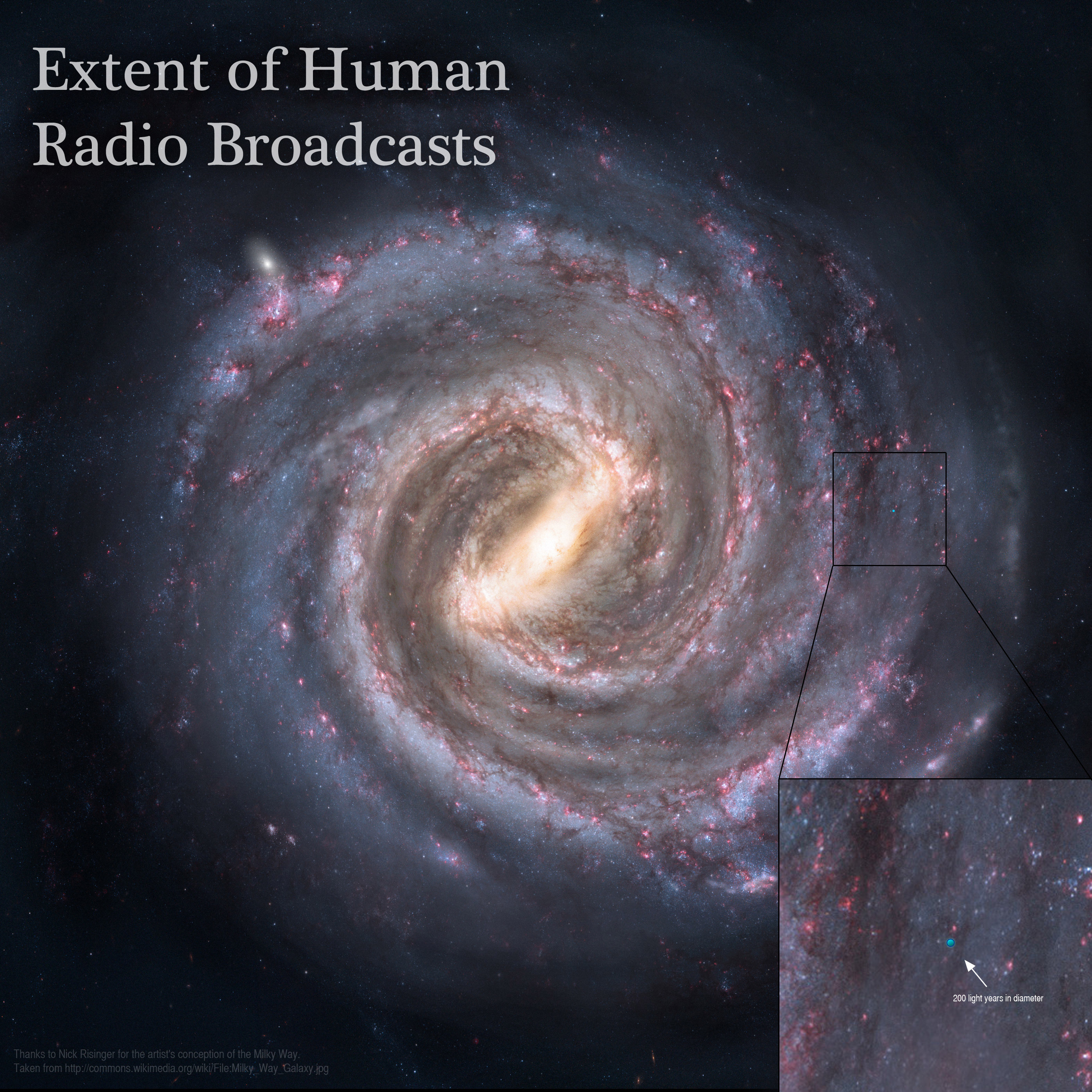
The Earth is invisible in this photo. Blue dot is illustrating 200 ly. Diameter.
Edit: to further blow your mind and put it in perspective it would take you 200 years to go from one edge of that blue dot to the other traveling at a constant speed of almost 300 million meters per second (186,000 miles/second).
mobyhead1 t1_j9tfejb wrote
Reply to comment by OhioVsEverything in Would an Earth-like planet with identical technology be able to detect signals from us? by lukinhasb
There is a caption, with an arrow pointing at the blue dot that reads “200 light years in diameter.”
The Earth is only about 8,000 miles in diameter.
The arrow isn’t pointing at the box.
Therefore the blue dot is a volume of space 200 light-years in diameter.
ExtonGuy t1_j9tfd4i wrote
Reply to comment by extra_specticles in Would an Earth-like planet with identical technology be able to detect signals from us? by lukinhasb
Let’s just keep this discussion to the Milky Way, okay? No need to bring in stuff many billions of light-years away, when the interesting aliens are the one most likely to communicate with us (if they exist), within a few 1000 light years.
lukinhasb OP t1_j9tf3ay wrote
Reply to comment by nosmelc in Would an Earth-like planet with identical technology be able to detect signals from us? by lukinhasb
Is radiowave signal the most appropriate for this kind of communication? Suppose that we want to send a signal out there to be picked up, would it be radio?
Does radio lose power when it travels long distances?
coffeestrainer000 t1_j9tf0ib wrote
Reply to comment by OhioVsEverything in Would an Earth-like planet with identical technology be able to detect signals from us? by lukinhasb
…Do you think the Galaxy is only like 1000ly wide?…
OhioVsEverything t1_j9texj4 wrote
Reply to comment by Substantial_Chair_78 in Would an Earth-like planet with identical technology be able to detect signals from us? by lukinhasb
What if it takes them 5000 Earth years to rotate around their own star just once and the last time they called was the earth year 1001. They'll not call again for a while.
andi_bk t1_j9tevx2 wrote
Reply to Would an Earth-like planet with identical technology be able to detect signals from us? by lukinhasb
Well yes and no… i guess…
If they had the technology and lived only maybe 5000 lightyears away, they could get our messages in about 5000 years… i believe that by then we would have met already because technology is advancing at a tremendous rate and we are already researching different new types of drives for space transportation. It’s certainly still a very long time until mankind will reach 0.1 times speed of light, but 5000 years? Who knows what we have until then…
If you think you know, what we will have in 5000 years: think again… our ancestors from 5000 years ago would simply be unable to understand what kinds of tech we have. It would be magic to them… a simple lighter would mean you have to be a god!
Now if we today send out a signal into space, those who would eventually receive it would probably already know before any earth signal ever reached them.
And yes, i believe that we will find a way to effectively travel faster than light in that kind of timeframe.
tjmick1992 t1_j9terr4 wrote
Reply to comment by nosmelc in Would an Earth-like planet with identical technology be able to detect signals from us? by lukinhasb
Wait wait wait you mean we have smaller galaxies closer?
Ruadhan2300 t1_j9tep90 wrote
Reply to comment by jamesycakes231 in Would an Earth-like planet with identical technology be able to detect signals from us? by lukinhasb
There's also signal-attenuation to consider.
Radio signals disperse in open space and eventually become indistinguishable from the background radiation.
For all but our most powerful directed transmissions, this is in the realm of a couple hundred lightyears at most.
A world 2000 lightyears away wouldn't be able to understand or recognise the signal even when the radio waves start passing it by. At best it'd be a slight increase in radio complexity drowned out by the cosmic background noise.
OhioVsEverything t1_j9teiwl wrote
Reply to comment by MobiusMule in Would an Earth-like planet with identical technology be able to detect signals from us? by lukinhasb
Is the blue dot just earth or the 200 light years or is the box 200 light years?
nosmelc t1_j9tea12 wrote
Reply to Would an Earth-like planet with identical technology be able to detect signals from us? by lukinhasb
An earth-like planet with a similar technological civilization would have to be no more than 122 light years away to detect our signals because we've only been using radio for that long. Most likely they'd have to be much closer or the signals would just be too weak to pick out from the background noise.
122 light years sounds like a long distance, but keep in mind that our Milky Way galaxy is over 100,000 light years across. Any other galaxy would be hopelessly too far away to ever receive a radio signal. The closest major galaxy is Andromeda at over 2.5 million light years away.
It's entirely possible there are several radio signals from other planets traveling from planets in our galaxy but they either haven't reached us yet or are too weak to pick up by the time they've crossed that vast distance.
Substantial_Chair_78 t1_j9td59z wrote
Reply to comment by jamesycakes231 in Would an Earth-like planet with identical technology be able to detect signals from us? by lukinhasb
What if they’ve been sending us messages for thousands of years? Maybe one every year to wish us a happy new year?
Pgapete1960 t1_j9tcxjv wrote
Reply to comment by the6thReplicant in Supermassive black hole on the run by DevilsRefugee
Just Imagine if that was true.
extra_specticles t1_j9tcb33 wrote
Reply to Would an Earth-like planet with identical technology be able to detect signals from us? by lukinhasb
Due the faster light speed expansion of the universe, there are always going to be parts of the universe that we'll never get signals from no matter how long we wait (given no ability to move faster than light ourselves). More and more as time goes on.
jamesycakes231 t1_j9tc6aa wrote
Reply to Would an Earth-like planet with identical technology be able to detect signals from us? by lukinhasb
It's possible to detect signals, but even if a planet 2,000 ly away has the same tech and sends us a message, we won't receive it until 4023. By then we could well be long gone.
MobiusMule t1_j9tbhvc wrote
Reply to Would an Earth-like planet with identical technology be able to detect signals from us? by lukinhasb
This image illustrates it nicely.
[deleted] OP t1_j9t86dj wrote
Reply to comment by MrTurdFace69 in Time dilation question by [deleted]
[removed]
the6thReplicant t1_j9t7r10 wrote
Reply to comment by Pgapete1960 in Supermassive black hole on the run by DevilsRefugee
I heard the lead singer was in a band in the 60s. They supposedly had a hit here and there. Nothing much happened to them.
NotAHamsterAtAll t1_j9t7huo wrote
Reply to comment by ToasterOvenHotTub in What are some of the major goals we hope to achieve, or discoveries that we hope to make, with the JWST? by m_and_t
Easy. There was no Big Bang.
(Because the theory is not compatible with actual observations.)
Now comes the hard part, if there was no Big Bang, then the observations that lead to the creation of the Big Bang hypothesis are interpreted wrongly. And that opens up for a lot of things to be changed.
ToasterOvenHotTub t1_j9t6dsf wrote
Reply to comment by NotAHamsterAtAll in What are some of the major goals we hope to achieve, or discoveries that we hope to make, with the JWST? by m_and_t
Ohh, that sounds exciting. What's the most likely alternative in your opinion?
nosmelc t1_j9th4j4 wrote
Reply to comment by lukinhasb in Would an Earth-like planet with identical technology be able to detect signals from us? by lukinhasb
Yes radio does lose power when it travels long distances.
I think radio might be the most appropriate for this kind of communication because it should be the first method of communication that technological civilizations discover. That means everybody should be able to send and receive radio.