Recent comments in /f/space
Bayonethics t1_jc2wzbg wrote
Reply to The largest NASA Hubble Space Telescope image ever assembled, this sweeping bird’s-eye view of a portion of the Andromeda galaxy. Credit: NASA, ESA by Davicho77
The people living close to the center of the galaxy must never get any sleep with how bright that region is
Medosten t1_jc2vmer wrote
typeOnegative77 t1_jc2v87j wrote
How is this possible? The light from the light house would have obliterated any light from the Milky Way? This is a composite for sure, but most probably from different places. Unless the photographer managed to switch off the lighthouse for an hour or so.
Cool nevertheless.
ElReptil t1_jc2qsbt wrote
Reply to comment by 14domino in The largest NASA Hubble Space Telescope image ever assembled, this sweeping bird’s-eye view of a portion of the Andromeda galaxy. Credit: NASA, ESA by Davicho77
> i assume in a few billion years as it gets closer it would get brighter and bigger
Bigger yes, but the surface brightness would actually stay the same (until you start to resolve individual stars). You would probably still be able to see more than you do now because the eye is better at seeing dim, large objects.
14domino t1_jc2nz0f wrote
Reply to comment by pestapokalypse in The largest NASA Hubble Space Telescope image ever assembled, this sweeping bird’s-eye view of a portion of the Andromeda galaxy. Credit: NASA, ESA by Davicho77
Can someone who’s good at math tell me how big andromeda would have to be in the sky before it is this bright? (ie i assume in a few billion years as it gets closer it would get brighter and bigger)
[deleted] t1_jc2kvgb wrote
anima99 t1_jc2kn8g wrote
Reply to comment by iKillBugs4Work_AMA in Pillars of Creation - cropped them differently and rotated to show their "frame" by Rockclimber88
Each star doesn't have to be a "system," per se. They can simply be massive balls of gas with rocks/ice/metals around them.
They may form into planet-sized chunks, but it's difficult to determine given their distance. Not to mention some of these stars don't live long enough to form their own systems as they can sometimes collide or spin too fast and just lose form.
Those stars may also be explosions or supernovas, but this is the limit of what I have personally read about without Googling them again.
TbonerT t1_jc2fhle wrote
Reply to comment by ZylonBane in The largest NASA Hubble Space Telescope image ever assembled, this sweeping bird’s-eye view of a portion of the Andromeda galaxy. Credit: NASA, ESA by Davicho77
Yeah. Andromeda has an apparent size of 3.167 by 1 degrees and this is only a portion of that. I'm pretty sure birds known for their distance sight have a wider field of view than that.
WaveofThought t1_jc29bqs wrote
Reply to comment by ssavrass in The largest NASA Hubble Space Telescope image ever assembled, this sweeping bird’s-eye view of a portion of the Andromeda galaxy. Credit: NASA, ESA by Davicho77
You can see it with the naked eye under dark skies, but only the brighter core, and it's still quite faint.
WaveofThought t1_jc297ue wrote
Reply to comment by I-melted in The largest NASA Hubble Space Telescope image ever assembled, this sweeping bird’s-eye view of a portion of the Andromeda galaxy. Credit: NASA, ESA by Davicho77
Its in the constellation Andromeda. I always find it by looking from the star Mirach to mu Andromidae, and following that path to about double its length.
[deleted] t1_jc252x8 wrote
[deleted] t1_jc23aid wrote
Reply to comment by danielravennest in Milky Way over Uruguayan Lighthouse. Credit: Mauricio Salazar by Davicho77
[removed]
danielravennest t1_jc22hwt wrote
Reply to comment by CodeCocina in Milky Way over Uruguayan Lighthouse. Credit: Mauricio Salazar by Davicho77
It is from the Greek, meaning "milky circle". The galaxy is a flattened disk, and we are inside it. So from our viewpoint it looks like a circle around the sky. They didn't have telescopes, so all they could see is a faint white band.
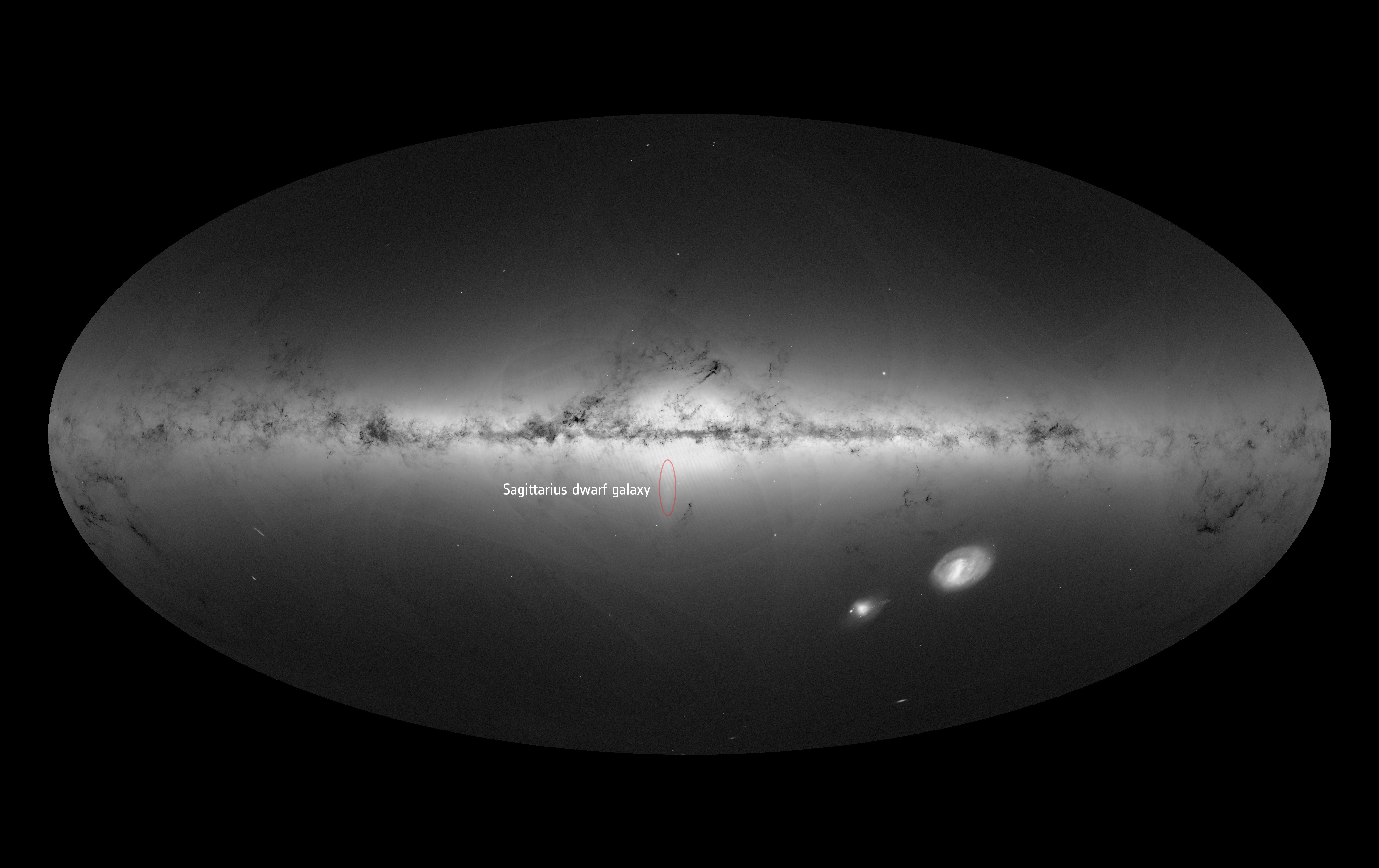
This is an all-sky view with our galaxy oriented horizontally. Sagittarius is a dwarf galaxy mostly hidden by the center of ours. It is on the other side. It is the nearest galaxy to our own, at 50,000 light years, and orbits the Milky Way. The two blobs on the lower right are the Magellanic Clouds, the next nearest, and also orbit the Milky Way. They are about 3 times farther, and much larger than the Sagittarius dwarf. Both will end up merged with the Milky Way eventually.
[deleted] t1_jc1vttz wrote
[removed]
I-melted t1_jc1v5bz wrote
Reply to comment by pestapokalypse in The largest NASA Hubble Space Telescope image ever assembled, this sweeping bird’s-eye view of a portion of the Andromeda galaxy. Credit: NASA, ESA by Davicho77
Oh dammit. That would be so cool.
I’m ashamed for not knowing, but where would I find it in the sky? In relation to the more obvious constellations?
Splive t1_jc1uv4g wrote
Reply to comment by drmirage809 in Pillars of Creation - cropped them differently and rotated to show their "frame" by Rockclimber88
Wait really? I'm so used to thinking about galactic level events happening over millions or billions of years. Had not expected that such a change could be on the timeline of humanity.
[deleted] t1_jc1uh1q wrote
[deleted] t1_jc1r7xg wrote
echochamber4liberals t1_jc1qf57 wrote
Reply to What if The Universe Has Always Existed by GhostCallOut2
To the human scale, by the most important measures, the universe has always existed.
ProjectDv2 t1_jc1pkna wrote
Reply to comment by Jazzlike-Outcome711 in Milky Way over Uruguayan Lighthouse. Credit: Mauricio Salazar by Davicho77
Yes, if you can get far enough away from urban areas, haze, and light pollution.
When I was younger I used to get away to extremely rural areas in the summer and lay in the middle of a back road on the warm asphalt, staring at the sky for hours. After my eyes adjusted, I could see the Milky Way and various gaseous formations. I haven't seen them in years now, it makes me really sad.
[deleted] t1_jc1mrql wrote
Reply to Full moon, southern hemisphere shot by EduardoVrd
[removed]
iKillBugs4Work_AMA t1_jc2xp0a wrote
Reply to comment by anima99 in Pillars of Creation - cropped them differently and rotated to show their "frame" by Rockclimber88
Got it. Thanks for the detailed explanation. I know what my next research rabbit hole will be. So much interesting stuff in a place that's so unknown to us.